

You are browsing environment: HUMAN GUT
CAZyme Information: MGYG000002310_08957
You are here: Home > Sequence: MGYG000002310_08957
Basic Information |
Genomic context |
Full Sequence |
Enzyme annotations |
CAZy signature domains |
CDD domains |
CAZyme hits |
PDB hits |
Swiss-Prot hits |
SignalP and Lipop annotations |
TMHMM annotations
Basic Information help
| Species | Microvirga massiliensis | |||||||||||
|---|---|---|---|---|---|---|---|---|---|---|---|---|
| Lineage | Bacteria; Proteobacteria; Alphaproteobacteria; Rhizobiales; Beijerinckiaceae; Microvirga; Microvirga massiliensis | |||||||||||
| CAZyme ID | MGYG000002310_08957 | |||||||||||
| CAZy Family | GT21 | |||||||||||
| CAZyme Description | hypothetical protein | |||||||||||
| CAZyme Property |
|
|||||||||||
| Genome Property |
|
|||||||||||
| Gene Location | Start: 5506; End: 6492 Strand: - | |||||||||||
CAZyme Signature Domains help
| Family | Start | End | Evalue | family coverage |
|---|---|---|---|---|
| GT21 | 39 | 234 | 2.8e-59 | 0.8497854077253219 |
CDD Domains download full data without filtering help
| Cdd ID | Domain | E-Value | qStart | qEnd | sStart | sEnd | Domain Description |
|---|---|---|---|---|---|---|---|
| cd02520 | Glucosylceramide_synthase | 2.08e-52 | 39 | 234 | 35 | 196 | Glucosylceramide synthase catalyzes the first glycosylation step of glycosphingolipid synthesis. UDP-glucose:N-acylsphingosine D-glucosyltransferase (glucosylceramide synthase or ceramide glucosyltransferase) catalyzes the first glycosylation step of glycosphingolipid synthesis. Its product, glucosylceramide, serves as the core of more than 300 glycosphingolipids (GSL). GSLs are a group of membrane components that have the lipid portion embedded in the outer plasma membrane leaflet and the sugar chains extended to the outer environment. Several lines of evidence suggest the importance of GSLs in various cellular processes such as differentiation, adhesion, proliferation, and cell-cell recognition. In pathogenic fungus Cryptococcus neoformans, glucosylceramide serves as an antigen that elicits an antibody response in patients and it is essential for fungal growth in host extracellular environment. |
| pfam13506 | Glyco_transf_21 | 9.24e-52 | 60 | 232 | 1 | 174 | Glycosyl transferase family 21. This is a family of ceramide beta-glucosyltransferases - EC:2.4.1.80. |
| TIGR03472 | HpnI | 1.38e-25 | 33 | 259 | 69 | 301 | hopanoid biosynthesis associated glycosyl transferase protein HpnI. This family of genes include a glycosyl transferase, group 2 domain (pfam00535) which are responsible, generally for the transfer of nucleotide-diphosphate sugars to substrates such as polysaccharides and lipids. The member of this clade from Acidithiobacillus ferrooxidans ATCC 23270 (AFE_0974) is found in the same locus as squalene-hopene cyclase (SHC, TIGR01507) and other genes associated with the biosynthesis of hopanoid natural products. Similarly, in Ralstonia eutropha JMP134 (Reut_B4902) this gene is adjacent to HpnAB, IspH and HpnH (TIGR03470), although SHC itself is elsewhere in the genome. Notably, this gene (here named HpnI) and three others form a conserved set (HpnIJKL) which occur in a subset of all genomes containing the SHC enzyme. This relationship was discerned using the method of partial phylogenetic profiling. This group includes Zymomonas mobilis, the organism where the initial hopanoid biosynthesis locus was described consisting of the genes HpnA-E and SHC (HpnF). Continuing past SHC are found a phosphorylase enzyme (ZMO0873, i.e. HpnG, TIGR03468) and another radical SAM enzyme (ZMO0874), HpnH. Although discontinuous in Z. mobilis, we continue the gene symbol sequence with HpnIJKL. Hopanoids are known to feature polar glycosyl head groups in many organisms. |
| COG1215 | BcsA | 1.10e-16 | 39 | 238 | 89 | 288 | Glycosyltransferase, catalytic subunit of cellulose synthase and poly-beta-1,6-N-acetylglucosamine synthase [Cell motility]. |
| cd04192 | GT_2_like_e | 2.64e-04 | 43 | 137 | 37 | 130 | Subfamily of Glycosyltransferase Family GT2 of unknown function. GT-2 includes diverse families of glycosyltransferases with a common GT-A type structural fold, which has two tightly associated beta/alpha/beta domains that tend to form a continuous central sheet of at least eight beta-strands. These are enzymes that catalyze the transfer of sugar moieties from activated donor molecules to specific acceptor molecules, forming glycosidic bonds. Glycosyltransferases have been classified into more than 90 distinct sequence based families. |
CAZyme Hits help
| Hit ID | E-Value | Query Start | Query End | Hit Start | Hit End |
|---|---|---|---|---|---|
| ACL62097.1 | 1.31e-133 | 33 | 295 | 69 | 329 |
| AWN44908.1 | 1.49e-132 | 33 | 296 | 79 | 340 |
| AWN44276.1 | 1.49e-132 | 33 | 296 | 79 | 340 |
| AWN44934.1 | 4.03e-124 | 33 | 296 | 70 | 332 |
| QJI87404.1 | 8.81e-124 | 39 | 296 | 72 | 329 |
Swiss-Prot Hits download full data without filtering help
| Hit ID | E-Value | Query Start | Query End | Hit Start | Hit End | Description |
|---|---|---|---|---|---|---|
| Q16739 | 1.38e-23 | 40 | 262 | 86 | 308 | Ceramide glucosyltransferase OS=Homo sapiens OX=9606 GN=UGCG PE=1 SV=1 |
| O88693 | 3.23e-22 | 40 | 262 | 86 | 308 | Ceramide glucosyltransferase OS=Mus musculus OX=10090 GN=Ugcg PE=1 SV=1 |
| Q5U4S8 | 1.13e-21 | 40 | 262 | 86 | 308 | Ceramide glucosyltransferase-B OS=Xenopus laevis OX=8355 GN=ugcg-b PE=2 SV=1 |
| Q9R0E0 | 1.13e-21 | 40 | 262 | 86 | 308 | Ceramide glucosyltransferase OS=Rattus norvegicus OX=10116 GN=Ugcg PE=1 SV=1 |
| Q5BL38 | 2.12e-21 | 40 | 262 | 86 | 308 | Ceramide glucosyltransferase OS=Xenopus tropicalis OX=8364 GN=ugcg PE=2 SV=1 |
SignalP and Lipop Annotations help
This protein is predicted as OTHER
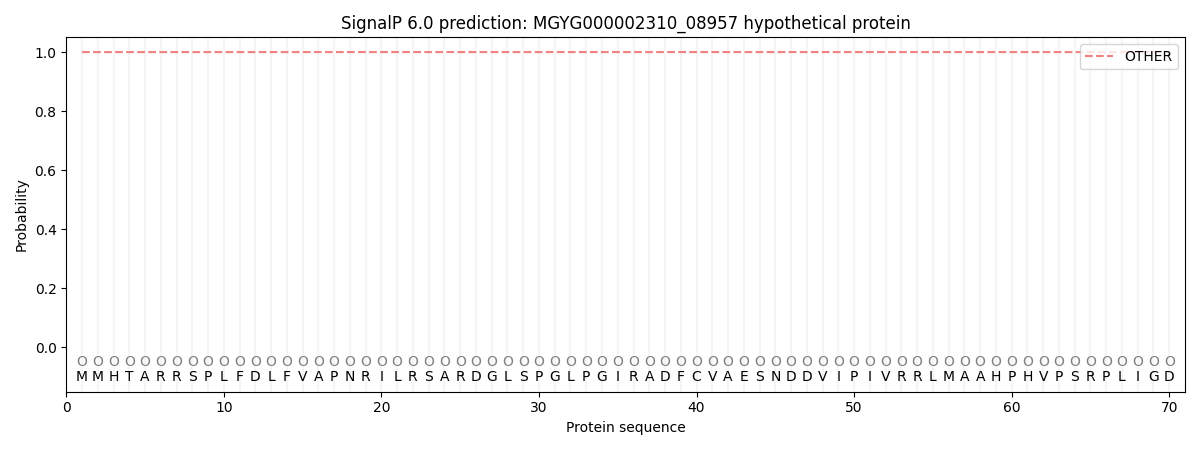
| Other | SP_Sec_SPI | LIPO_Sec_SPII | TAT_Tat_SPI | TATLIP_Sec_SPII | PILIN_Sec_SPIII |
|---|---|---|---|---|---|
| 1.000045 | 0.000000 | 0.000000 | 0.000000 | 0.000000 | 0.000000 |