

You are browsing environment: HUMAN GUT
CAZyme Information: MGYG000004667_04344
You are here: Home > Sequence: MGYG000004667_04344
Basic Information |
Genomic context |
Full Sequence |
Enzyme annotations |
CAZy signature domains |
CDD domains |
CAZyme hits |
PDB hits |
Swiss-Prot hits |
SignalP and Lipop annotations |
TMHMM annotations
Basic Information help
| Species | Clostridium beijerinckii | |||||||||||
|---|---|---|---|---|---|---|---|---|---|---|---|---|
| Lineage | Bacteria; Firmicutes_A; Clostridia; Clostridiales; Clostridiaceae; Clostridium; Clostridium beijerinckii | |||||||||||
| CAZyme ID | MGYG000004667_04344 | |||||||||||
| CAZy Family | GT0 | |||||||||||
| CAZyme Description | UDP-2,4-diacetamido-2,4,6-trideoxy-beta-L-altropyranose hydrolase | |||||||||||
| CAZyme Property |
|
|||||||||||
| Genome Property |
|
|||||||||||
| Gene Location | Start: 82400; End: 83431 Strand: - | |||||||||||
CDD Domains download full data without filtering help
| Cdd ID | Domain | E-Value | qStart | qEnd | sStart | sEnd | Domain Description |
|---|---|---|---|---|---|---|---|
| TIGR03590 | PseG | 1.29e-73 | 2 | 278 | 1 | 279 | UDP-2,4-diacetamido-2,4,6-trideoxy-beta-L-altropyranose hydrolase. This protein is found in association with enzymes involved in the biosynthesis of pseudaminic acid, a component of polysaccharide in certain Pseudomonas strains as well as a modification of flagellin in Campylobacter and Hellicobacter. The role of this protein is unclear, although it may participate in N-acetylation in conjunction with, or in the absence of PseH (TIGR03585) as it often scores above the trusted cutoff to pfam00583 representing a family of acetyltransferases. |
| COG3980 | SpsG | 7.21e-55 | 1 | 332 | 1 | 317 | Spore coat polysaccharide biosynthesis protein SpsG, predicted glycosyltransferase [Cell wall/membrane/envelope biogenesis]. |
| cd03785 | GT28_MurG | 5.44e-07 | 2 | 333 | 1 | 349 | undecaprenyldiphospho-muramoylpentapeptide beta-N-acetylglucosaminyltransferase. MurG (EC 2.4.1.227) is an N-acetylglucosaminyltransferase, the last enzyme involved in the intracellular phase of peptidoglycan biosynthesis. It transfers N-acetyl-D-glucosamine (GlcNAc) from UDP-GlcNAc to the C4 hydroxyl of a lipid-linked N-acetylmuramoyl pentapeptide (NAM). The resulting disaccharide is then transported across the cell membrane, where it is polymerized into NAG-NAM cell-wall repeat structure. MurG belongs to the GT-B structural superfamily of glycoslytransferases, which have characteristic N- and C-terminal domains, each containing a typical Rossmann fold. The two domains have high structural homology despite minimal sequence homology. The large cleft that separates the two domains includes the catalytic center and permits a high degree of flexibility. |
| PRK00726 | murG | 0.003 | 233 | 339 | 245 | 355 | undecaprenyldiphospho-muramoylpentapeptide beta-N- acetylglucosaminyltransferase; Provisional |
| cd17507 | GT28_Beta-DGS-like | 0.006 | 173 | 326 | 200 | 359 | beta-diglucosyldiacylglycerol synthase and similar proteins. beta-diglucosyldiacylglycerol synthase (processive diacylglycerol beta-glucosyltransferase EC 2.4.1.315) is involved in the biosynthesis of both the bilayer- and non-bilayer-forming membrane glucolipids. This family of glycosyltransferases also contains plant major galactolipid synthase (chloroplastic monogalactosyldiacylglycerol synthase 1 EC 2.4.1.46). Glycosyltransferases catalyze the transfer of sugar moieties from activated donor molecules to specific acceptor molecules, forming glycosidic bonds. The acceptor molecule can be a lipid, a protein, a heterocyclic compound, or another carbohydrate residue. The structures of the formed glycoconjugates are extremely diverse, reflecting a wide range of biological functions. The members of this family share a common GTB topology, one of the two protein topologies observed for nucleotide-sugar-dependent glycosyltransferases. GTB proteins have distinct N- and C- terminal domains each containing a typical Rossmann fold. The two domains have high structural homology despite minimal sequence homology. The large cleft that separates the two domains includes the catalytic center and permits a high degree of flexibility. |
CAZyme Hits help
| Hit ID | E-Value | Query Start | Query End | Hit Start | Hit End |
|---|---|---|---|---|---|
| AGF58283.1 | 4.16e-169 | 1 | 339 | 1 | 339 |
| AQR96971.1 | 2.13e-165 | 1 | 339 | 1 | 339 |
| QUF76874.1 | 5.65e-113 | 1 | 340 | 1 | 344 |
| ABR36387.1 | 5.85e-113 | 1 | 340 | 2 | 345 |
| AIU00843.1 | 5.85e-113 | 1 | 340 | 2 | 345 |
PDB Hits download full data without filtering help
| Hit ID | E-Value | Query Start | Query End | Hit Start | Hit End | Description |
|---|---|---|---|---|---|---|
| 3HBM_A | 2.78e-15 | 2 | 279 | 2 | 264 | ChainA, UDP-sugar hydrolase [Campylobacter jejuni subsp. jejuni NCTC 11168 = ATCC 700819],3HBN_A Chain A, UDP-sugar hydrolase [Campylobacter jejuni subsp. jejuni NCTC 11168 = ATCC 700819] |
Swiss-Prot Hits download full data without filtering help
| Hit ID | E-Value | Query Start | Query End | Hit Start | Hit End | Description |
|---|---|---|---|---|---|---|
| Q58462 | 3.05e-26 | 1 | 263 | 1 | 266 | Uncharacterized protein MJ1062 OS=Methanocaldococcus jannaschii (strain ATCC 43067 / DSM 2661 / JAL-1 / JCM 10045 / NBRC 100440) OX=243232 GN=MJ1062 PE=1 SV=1 |
| Q0P8U5 | 6.92e-17 | 1 | 279 | 1 | 264 | UDP-2,4-diacetamido-2,4,6-trideoxy-beta-L-altropyranose hydrolase OS=Campylobacter jejuni subsp. jejuni serotype O:2 (strain ATCC 700819 / NCTC 11168) OX=192222 GN=pseG PE=1 SV=1 |
| A1W0U6 | 1.77e-16 | 1 | 279 | 1 | 264 | UDP-2,4-diacetamido-2,4,6-trideoxy-beta-L-altropyranose hydrolase OS=Campylobacter jejuni subsp. jejuni serotype O:23/36 (strain 81-176) OX=354242 GN=pseG PE=3 SV=1 |
| P39627 | 1.21e-13 | 1 | 328 | 1 | 324 | Spore coat polysaccharide biosynthesis protein SpsG OS=Bacillus subtilis (strain 168) OX=224308 GN=spsG PE=4 SV=2 |
| O25093 | 3.19e-07 | 82 | 271 | 283 | 461 | Pseudaminic acid cytidylyltransferase and UDP-2,4-diacetamido-2,4,6-trideoxy-beta-L-altropyranose hydrolase OS=Helicobacter pylori (strain ATCC 700392 / 26695) OX=85962 GN=HP_0326 PE=3 SV=1 |
SignalP and Lipop Annotations help
This protein is predicted as OTHER
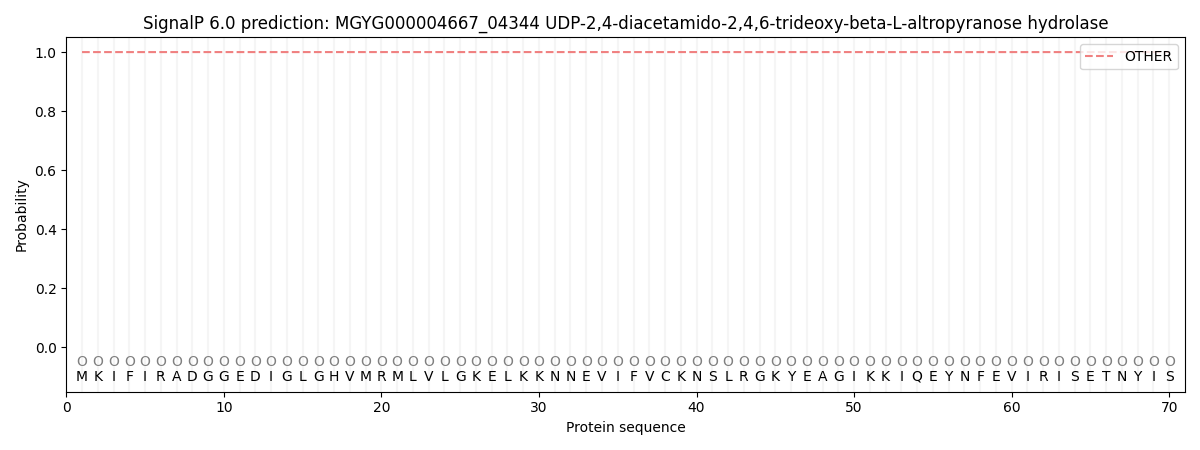
| Other | SP_Sec_SPI | LIPO_Sec_SPII | TAT_Tat_SPI | TATLIP_Sec_SPII | PILIN_Sec_SPIII |
|---|---|---|---|---|---|
| 1.000056 | 0.000000 | 0.000000 | 0.000000 | 0.000000 | 0.000000 |