
You are browsing environment: HUMAN GUT
CAZyme Information: MGYG000001507_03103
You are here: Home > Sequence: MGYG000001507_03103
Basic Information |
Genomic context |
Full Sequence |
Enzyme annotations |
CAZy signature domains |
CDD domains |
CAZyme hits |
PDB hits |
Swiss-Prot hits |
SignalP and Lipop annotations |
TMHMM annotations
Basic Information help
| Species | Paenibacillus ihuae | |||||||||||
|---|---|---|---|---|---|---|---|---|---|---|---|---|
| Lineage | Bacteria; Firmicutes; Bacilli; Paenibacillales; Paenibacillaceae; Paenibacillus; Paenibacillus ihuae | |||||||||||
| CAZyme ID | MGYG000001507_03103 | |||||||||||
| CAZy Family | CBM50 | |||||||||||
| CAZyme Description | Protein TolB | |||||||||||
| CAZyme Property |
|
|||||||||||
| Genome Property |
|
|||||||||||
| Gene Location | Start: 3258586; End: 3259956 Strand: - | |||||||||||
CDD Domains download full data without filtering help
| Cdd ID | Domain | E-Value | qStart | qEnd | sStart | sEnd | Domain Description |
|---|---|---|---|---|---|---|---|
| PRK03629 | tolB | 8.58e-11 | 51 | 272 | 204 | 427 | Tol-Pal system protein TolB. |
| COG0823 | TolB | 7.25e-10 | 14 | 272 | 206 | 423 | Periplasmic component of the Tol biopolymer transport system [Intracellular trafficking, secretion, and vesicular transport]. |
| COG0823 | TolB | 1.03e-09 | 116 | 324 | 139 | 341 | Periplasmic component of the Tol biopolymer transport system [Intracellular trafficking, secretion, and vesicular transport]. |
| COG2319 | WD40 | 1.42e-09 | 2 | 285 | 157 | 433 | WD40 repeat [General function prediction only]. |
| sd00039 | 7WD40 | 3.24e-09 | 88 | 326 | 1 | 236 | WD40 repeats in seven bladed beta propellers. The WD40 repeat is found in a number of eukaryotic proteins that cover a wide variety of functions including adaptor/regulatory modules in signal transduction, pre-mRNA processing, and cytoskeleton assembly. It typically contains a GH dipeptide 11-24 residues from its N-terminus and the WD dipeptide at its C-terminus and is 40 residues long, hence the name WD40. Between the GH and WD dipeptides lies a conserved core. It forms a propeller-like structure with several blades where each blade is composed of a four-stranded anti-parallel beta-sheet. The WD40 sequence repeat originally described in literature forms the first three strands of one blade and the last strand in the next blade. The C-terminal WD40 repeat completes the blade structure of the N-terminal WD40 repeat to create the closed ring propeller-structure. The residues on the top and bottom surface of the propeller are proposed to coordinate interactions with other proteins and/or small ligands, allowing them to bind either stably or reversibly. |
CAZyme Hits help
| Hit ID | E-Value | Query Start | Query End | Hit Start | Hit End |
|---|---|---|---|---|---|
| QOK29155.1 | 5.89e-183 | 12 | 456 | 158 | 605 |
| AND40662.1 | 3.36e-182 | 12 | 456 | 158 | 605 |
| QGH33144.1 | 4.10e-178 | 12 | 456 | 158 | 604 |
| AYA74756.1 | 1.42e-173 | 13 | 456 | 159 | 604 |
| QBP40070.1 | 2.42e-169 | 12 | 455 | 158 | 602 |
Swiss-Prot Hits help
SignalP and Lipop Annotations help
This protein is predicted as OTHER
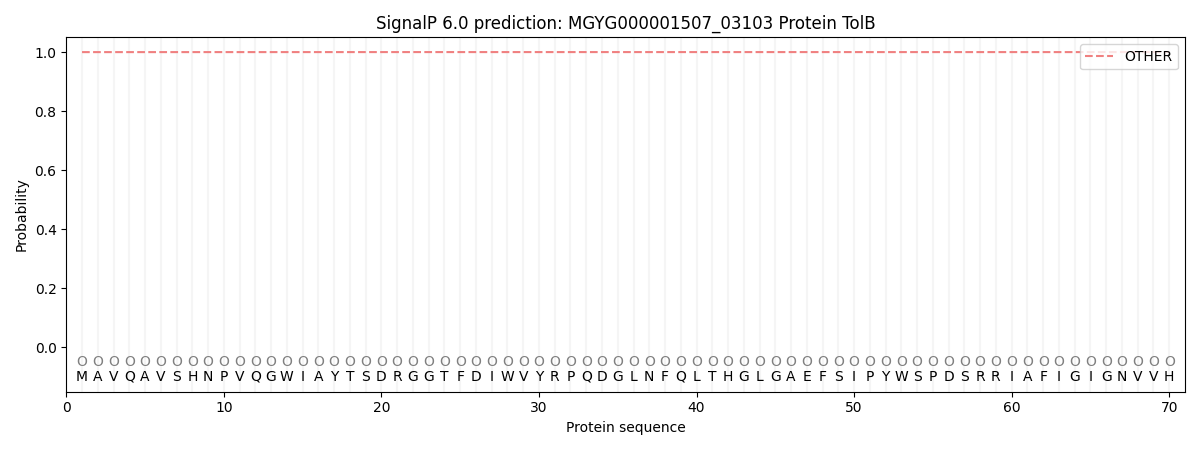
| Other | SP_Sec_SPI | LIPO_Sec_SPII | TAT_Tat_SPI | TATLIP_Sec_SPII | PILIN_Sec_SPIII |
|---|---|---|---|---|---|
| 1.000030 | 0.000000 | 0.000000 | 0.000000 | 0.000000 | 0.000000 |