
You are browsing environment: HUMAN GUT
CAZyme Information: MGYG000001553_02455
You are here: Home > Sequence: MGYG000001553_02455
Basic Information |
Genomic context |
Full Sequence |
Enzyme annotations |
CAZy signature domains |
CDD domains |
CAZyme hits |
PDB hits |
Swiss-Prot hits |
SignalP and Lipop annotations |
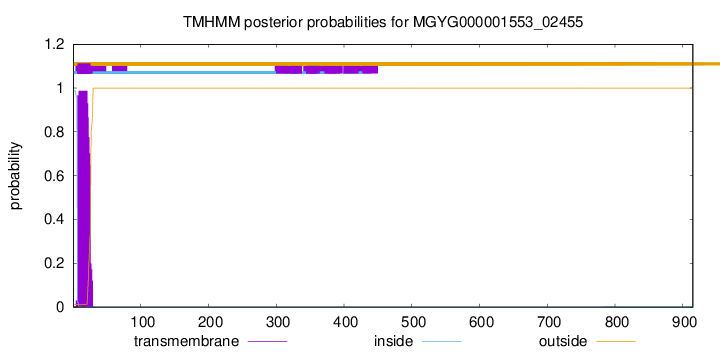
TMHMM annotations
Basic Information help
| Species | Clostridium_P mediterraneense | |||||||||||
|---|---|---|---|---|---|---|---|---|---|---|---|---|
| Lineage | Bacteria; Firmicutes_A; Clostridia; Clostridiales; Clostridiaceae; Clostridium_P; Clostridium_P mediterraneense | |||||||||||
| CAZyme ID | MGYG000001553_02455 | |||||||||||
| CAZy Family | GH73 | |||||||||||
| CAZyme Description | hypothetical protein | |||||||||||
| CAZyme Property |
|
|||||||||||
| Genome Property |
|
|||||||||||
| Gene Location | Start: 2187920; End: 2190667 Strand: - | |||||||||||
CDD Domains download full data without filtering help
| Cdd ID | Domain | E-Value | qStart | qEnd | sStart | sEnd | Domain Description |
|---|---|---|---|---|---|---|---|
| cd06583 | PGRP | 1.74e-26 | 766 | 892 | 2 | 124 | Peptidoglycan recognition proteins (PGRPs) are pattern recognition receptors that bind, and in certain cases, hydrolyze peptidoglycans (PGNs) of bacterial cell walls. PGRPs have been divided into three classes: short PGRPs (PGRP-S), that are small (20 kDa) extracellular proteins; intermediate PGRPs (PGRP-I) that are 40-45 kDa and are predicted to be transmembrane proteins; and long PGRPs (PGRP-L), up to 90 kDa, which may be either intracellular or transmembrane. Several structures of PGRPs are known in insects and mammals, some bound with substrates like Muramyl Tripeptide (MTP) or Tracheal Cytotoxin (TCT). The substrate binding site is conserved in PGRP-LCx, PGRP-LE, and PGRP-Ialpha proteins. This family includes Zn-dependent N-Acetylmuramoyl-L-alanine Amidase, EC:3.5.1.28. This enzyme cleaves the amide bond between N-acetylmuramoyl and L-amino acids, preferentially D-lactyl-L-Ala, in bacterial cell walls. The structure for the bacteriophage T7 lysozyme shows that two of the conserved histidines and a cysteine are zinc binding residues. Site-directed mutagenesis of T7 lysozyme indicates that two conserved residues, a Tyr and a Lys, are important for amidase activity. |
| pfam01510 | Amidase_2 | 2.44e-25 | 766 | 893 | 2 | 121 | N-acetylmuramoyl-L-alanine amidase. This family includes zinc amidases that have N-acetylmuramoyl-L-alanine amidase activity EC:3.5.1.28. This enzyme domain cleaves the amide bond between N-acetylmuramoyl and L-amino acids in bacterial cell walls (preferentially: D-lactyl-L-Ala). The structure is known for the bacteriophage T7 structure and shows that two of the conserved histidines are zinc binding. |
| smart00701 | PGRP | 2.66e-16 | 759 | 879 | 21 | 135 | Animal peptidoglycan recognition proteins homologous to Bacteriophage T3 lysozyme. The bacteriophage molecule, but not its moth homologue, has been shown to have N-acetylmuramoyl-L-alanine amidase activity. One member of this family, Tag7, is a cytokine. |
| smart00644 | Ami_2 | 7.55e-12 | 765 | 891 | 2 | 126 | Ami_2 domain. |
| PHA00447 | PHA00447 | 6.43e-10 | 767 | 892 | 11 | 131 | lysozyme |
CAZyme Hits help
| Hit ID | E-Value | Query Start | Query End | Hit Start | Hit End |
|---|---|---|---|---|---|
| AYE34895.1 | 4.01e-163 | 27 | 744 | 34 | 778 |
| QAS60290.1 | 5.95e-162 | 27 | 744 | 34 | 778 |
| QLY79091.1 | 4.96e-127 | 195 | 744 | 38 | 586 |
| AGK97878.1 | 1.05e-109 | 200 | 741 | 38 | 591 |
| ADL53568.1 | 1.91e-93 | 184 | 740 | 122 | 699 |
PDB Hits download full data without filtering help
| Hit ID | E-Value | Query Start | Query End | Hit Start | Hit End | Description |
|---|---|---|---|---|---|---|
| 6SRT_A | 5.69e-27 | 766 | 904 | 41 | 166 | EndolysineN-acetylmuramoyl-L-alanine amidase LysCS from Clostridium intestinale URNW [Clostridium intestinale URNW] |
| 6SSC_A | 1.07e-26 | 766 | 904 | 64 | 189 | N-acetylmuramoyl-L-alanineamidase LysC from Clostridium intestinale URNW [Clostridium intestinale] |
| 7F5I_A | 2.22e-17 | 764 | 900 | 29 | 152 | ChainA, amidase [Clostridium perfringens str. 13] |
| 4Z8I_A | 6.59e-11 | 768 | 902 | 89 | 221 | Crystalstructure of Branchiostoma belcheri tsingtauense peptidoglycan recognition protein 3 [Branchiostoma belcheri tsingtauense] |
| 4ZXM_A | 8.73e-11 | 768 | 902 | 118 | 250 | Crystalstructure of PGRP domain from Branchiostoma belcheri tsingtauense peptidoglycan recognition protein 3 [Branchiostoma belcheri tsingtauense] |
Swiss-Prot Hits download full data without filtering help
| Hit ID | E-Value | Query Start | Query End | Hit Start | Hit End | Description |
|---|---|---|---|---|---|---|
| Q9V4X2 | 1.26e-11 | 762 | 894 | 40 | 171 | Peptidoglycan-recognition protein SC2 OS=Drosophila melanogaster OX=7227 GN=PGRP-SC2 PE=2 SV=1 |
| Q70PU1 | 3.15e-11 | 770 | 894 | 48 | 171 | Peptidoglycan-recognition protein SC2 OS=Drosophila simulans OX=7240 GN=PGRP-SC2 PE=3 SV=1 |
| C0HK99 | 5.93e-11 | 762 | 892 | 41 | 170 | Peptidoglycan-recognition protein SC1b OS=Drosophila melanogaster OX=7227 GN=PGRP-SC1b PE=1 SV=1 |
| C0HK98 | 5.93e-11 | 762 | 892 | 41 | 170 | Peptidoglycan-recognition protein SC1a OS=Drosophila melanogaster OX=7227 GN=PGRP-SC1a PE=3 SV=1 |
| Q70PU2 | 6.80e-10 | 762 | 892 | 41 | 170 | Peptidoglycan-recognition protein SC1a/b OS=Drosophila simulans OX=7240 GN=PGRP-SC1a PE=3 SV=1 |
SignalP and Lipop Annotations help
This protein is predicted as SP
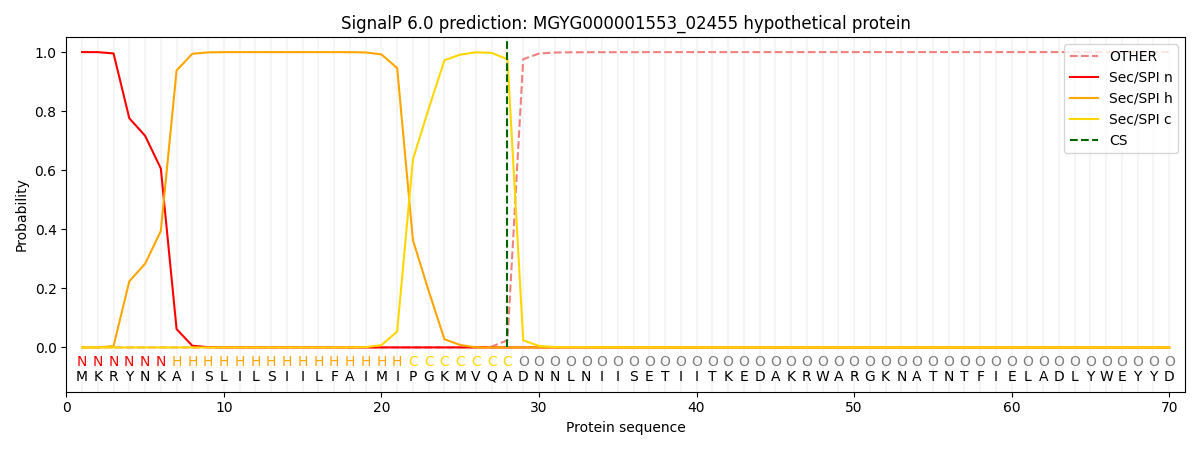
| Other | SP_Sec_SPI | LIPO_Sec_SPII | TAT_Tat_SPI | TATLIP_Sec_SPII | PILIN_Sec_SPIII |
|---|---|---|---|---|---|
| 0.000281 | 0.999025 | 0.000186 | 0.000171 | 0.000158 | 0.000153 |