

You are browsing environment: HUMAN GUT
CAZyme Information: MGYG000002311_02087
You are here: Home > Sequence: MGYG000002311_02087
Basic Information |
Genomic context |
Full Sequence |
Enzyme annotations |
CAZy signature domains |
CDD domains |
CAZyme hits |
PDB hits |
Swiss-Prot hits |
SignalP and Lipop annotations |
TMHMM annotations
Basic Information help
| Species | Vibrio cholerae | |||||||||||
|---|---|---|---|---|---|---|---|---|---|---|---|---|
| Lineage | Bacteria; Proteobacteria; Gammaproteobacteria; Enterobacterales; Vibrionaceae; Vibrio; Vibrio cholerae | |||||||||||
| CAZyme ID | MGYG000002311_02087 | |||||||||||
| CAZy Family | GT1 | |||||||||||
| CAZyme Description | hypothetical protein | |||||||||||
| CAZyme Property |
|
|||||||||||
| Genome Property |
|
|||||||||||
| Gene Location | Start: 2346759; End: 2347847 Strand: - | |||||||||||
CDD Domains download full data without filtering help
| Cdd ID | Domain | E-Value | qStart | qEnd | sStart | sEnd | Domain Description |
|---|---|---|---|---|---|---|---|
| TIGR00661 | MJ1255 | 0.0 | 2 | 311 | 1 | 321 | conserved hypothetical protein. This model represents nearly the full length of MJ1255 from Methanococcus jannaschii and of an unpublished protein from Vibrio cholerae, as well as the C-terminal half of a protein from Methanobacterium thermoautotrophicum. A small region (~50 amino acids) within the domain appears related to a family of sugar transferases. [Hypothetical proteins, Conserved] |
| COG1819 | YjiC | 3.79e-73 | 1 | 362 | 2 | 398 | UDP:flavonoid glycosyltransferase YjiC, YdhE family [Carbohydrate transport and metabolism]. |
| pfam13528 | Glyco_trans_1_3 | 5.32e-32 | 1 | 282 | 1 | 298 | Glycosyl transferase family 1. |
| cd03785 | GT28_MurG | 2.92e-04 | 2 | 152 | 1 | 149 | undecaprenyldiphospho-muramoylpentapeptide beta-N-acetylglucosaminyltransferase. MurG (EC 2.4.1.227) is an N-acetylglucosaminyltransferase, the last enzyme involved in the intracellular phase of peptidoglycan biosynthesis. It transfers N-acetyl-D-glucosamine (GlcNAc) from UDP-GlcNAc to the C4 hydroxyl of a lipid-linked N-acetylmuramoyl pentapeptide (NAM). The resulting disaccharide is then transported across the cell membrane, where it is polymerized into NAG-NAM cell-wall repeat structure. MurG belongs to the GT-B structural superfamily of glycoslytransferases, which have characteristic N- and C-terminal domains, each containing a typical Rossmann fold. The two domains have high structural homology despite minimal sequence homology. The large cleft that separates the two domains includes the catalytic center and permits a high degree of flexibility. |
CAZyme Hits help
| Hit ID | E-Value | Query Start | Query End | Hit Start | Hit End |
|---|---|---|---|---|---|
| AAF95629.1 | 3.25e-278 | 1 | 362 | 1 | 362 |
| BBE11592.1 | 3.25e-278 | 1 | 362 | 1 | 362 |
| SPM15092.1 | 3.25e-278 | 1 | 362 | 1 | 362 |
| SPM20365.1 | 3.25e-278 | 1 | 362 | 1 | 362 |
| ARB82492.1 | 3.25e-278 | 1 | 362 | 1 | 362 |
Swiss-Prot Hits help
SignalP and Lipop Annotations help
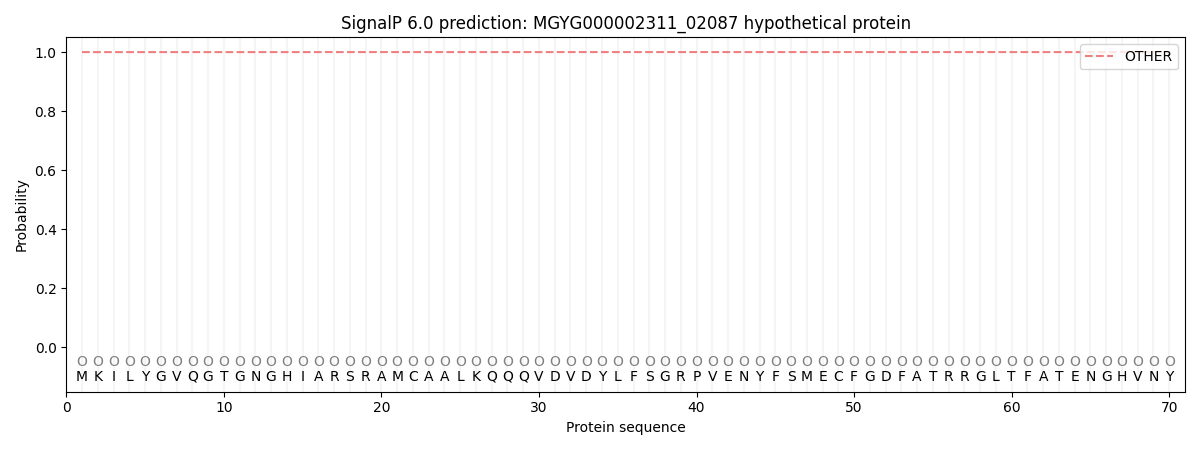
This protein is predicted as OTHER
| Other | SP_Sec_SPI | LIPO_Sec_SPII | TAT_Tat_SPI | TATLIP_Sec_SPII | PILIN_Sec_SPIII |
|---|---|---|---|---|---|
| 1.000053 | 0.000000 | 0.000000 | 0.000000 | 0.000000 | 0.000000 |