

You are browsing environment: HUMAN GUT
CAZyme Information: MGYG000002356_02951
You are here: Home > Sequence: MGYG000002356_02951
Basic Information |
Genomic context |
Full Sequence |
Enzyme annotations |
CAZy signature domains |
CDD domains |
CAZyme hits |
PDB hits |
Swiss-Prot hits |
SignalP and Lipop annotations |
TMHMM annotations
Basic Information help
| Species | Bacillus_A wiedmannii | |||||||||||
|---|---|---|---|---|---|---|---|---|---|---|---|---|
| Lineage | Bacteria; Firmicutes; Bacilli; Bacillales; Bacillaceae_G; Bacillus_A; Bacillus_A wiedmannii | |||||||||||
| CAZyme ID | MGYG000002356_02951 | |||||||||||
| CAZy Family | GT2 | |||||||||||
| CAZyme Description | Gramicidin S synthase 2 | |||||||||||
| CAZyme Property |
|
|||||||||||
| Genome Property |
|
|||||||||||
| Gene Location | Start: 89; End: 3139 Strand: + | |||||||||||
CDD Domains download full data without filtering help
| Cdd ID | Domain | E-Value | qStart | qEnd | sStart | sEnd | Domain Description |
|---|---|---|---|---|---|---|---|
| cd17655 | A_NRPS_Bac | 0.0 | 2 | 468 | 19 | 490 | bacitracin synthetase and related proteins. This family of the adenylation (A) domain of nonribosomal peptide synthases (NRPS) includes bacitracin synthetases 1, 2, and 3 (BA1, also known as ATP-dependent cysteine adenylase or cysteine activase, BA2, also known as ATP-dependent lysine adenylase or lysine activase, and BA3, also known as ATP-dependent isoleucine adenylase or isoleucine activase) in Bacilli. Bacitracin is a mixture of related cyclic peptides used as a polypeptide antibiotic. This family also includes gramicidin synthetase 1 involved in synthesis of the cyclic peptide antibiotic gramicidin S via activation of phenylalanine. NRPSs are large multifunctional enzymes which synthesize many therapeutically useful peptides in bacteria and fungi via a template-directed, nucleic acid independent nonribosomal mechanism. These natural products include antibiotics, immunosuppressants, plant and animal toxins, and enzyme inhibitors. NRPS has a distinct modular structure in which each module is responsible for the recognition, activation, and in some cases, modification of a single amino acid residue of the final peptide product. The modules can be subdivided into domains that catalyze specific biochemical reactions. |
| cd05930 | A_NRPS | 0.0 | 2 | 464 | 9 | 444 | The adenylation domain of nonribosomal peptide synthetases (NRPS). The adenylation (A) domain of NRPS recognizes a specific amino acid or hydroxy acid and activates it as an (amino) acyl adenylate by hydrolysis of ATP. The activated acyl moiety then forms a thioester bond to the enzyme-bound cofactor phosphopantetheine of a peptidyl carrier protein domain. NRPSs are large multifunctional enzymes which synthesize many therapeutically useful peptides in bacteria and fungi via a template-directed, nucleic acid independent nonribosomal mechanism. These natural products include antibiotics, immunosuppressants, plant and animal toxins, and enzyme inhibitors. NRPS has a distinct modular structure in which each module is responsible for the recognition, activation, and in some cases, modification of a single amino acid residue of the final peptide product. The modules can be subdivided into domains that catalyze specific biochemical reactions. |
| PRK12467 | PRK12467 | 0.0 | 2 | 1004 | 534 | 1564 | peptide synthase; Provisional |
| PRK12316 | PRK12316 | 0.0 | 3 | 1004 | 2026 | 3047 | peptide synthase; Provisional |
| cd12117 | A_NRPS_Srf_like | 0.0 | 1 | 464 | 18 | 483 | The adenylation domain of nonribosomal peptide synthetases (NRPS), including Bacillus subtilis termination module Surfactin (SrfA-C). The adenylation (A) domain of NRPS recognizes a specific amino acid or hydroxy acid and activates it as an (amino) acyl adenylate by hydrolysis of ATP. The activated acyl moiety then forms a thioester to the enzyme-bound cofactor phosphopantetheine of a peptidyl carrier protein domain. NRPSs are large multifunctional enzymes which synthesize many therapeutically useful peptides in bacteria and fungi via a template-directed, nucleic acid independent nonribosomal mechanism. These natural products include antibiotics, immunosuppressants, plant and animal toxins, and enzyme inhibitors. NRPS has a distinct modular structure in which each module is responsible for the recognition, activation, and, in some cases, modification of a single amino acid residue of the final peptide product. The modules can be subdivided into domains that catalyze specific biochemical reactions. This family includes the adenylation domain of the Bacillus subtilis termination module (Surfactin domain, SrfA-C) which recognizes a specific amino acid building block, which is then activated and transferred to the terminal thiol of the 4'-phosphopantetheine (Ppan) arm of the downstream peptidyl carrier protein (PCP) domain. |
CAZyme Hits help
| Hit ID | E-Value | Query Start | Query End | Hit Start | Hit End |
|---|---|---|---|---|---|
| QND46664.1 | 7.95e-181 | 2 | 1005 | 1031 | 2064 |
| AFZ04852.1 | 1.20e-131 | 2 | 552 | 606 | 1185 |
| ACX49739.1 | 2.07e-124 | 6 | 978 | 486 | 1498 |
| BAY30132.1 | 7.61e-114 | 2 | 547 | 601 | 1177 |
| BAZ00088.1 | 1.67e-111 | 2 | 547 | 601 | 1175 |
PDB Hits download full data without filtering help
| Hit ID | E-Value | Query Start | Query End | Hit Start | Hit End | Description |
|---|---|---|---|---|---|---|
| 5U89_A | 1.86e-208 | 2 | 1000 | 46 | 1071 | Crystalstructure of a cross-module fragment from the dimodular NRPS DhbF [Geobacillus sp. Y4.1MC1] |
| 6MFW_A | 3.95e-197 | 3 | 988 | 228 | 1188 | Crystalstructure of a 4-domain construct of LgrA in the substrate donation state [Brevibacillus parabrevis] |
| 6MFX_A | 2.17e-196 | 3 | 988 | 228 | 1188 | Crystalstructure of a 4-domain construct of a mutant of LgrA in the substrate donation state [Brevibacillus parabrevis] |
| 6MFY_A | 1.06e-192 | 3 | 997 | 228 | 1207 | Crystalstructure of a 5-domain construct of LgrA in the substrate donation state [Brevibacillus parabrevis],6MG0_A Crystal structure of a 5-domain construct of LgrA in the thiolation state [Brevibacillus parabrevis],6MG0_B Crystal structure of a 5-domain construct of LgrA in the thiolation state [Brevibacillus parabrevis] |
| 6MFZ_A | 4.99e-192 | 3 | 997 | 228 | 1207 | Crystalstructure of dimodular LgrA in a condensation state [Brevibacillus parabrevis],6MFZ_B Crystal structure of dimodular LgrA in a condensation state [Brevibacillus parabrevis] |
Swiss-Prot Hits download full data without filtering help
| Hit ID | E-Value | Query Start | Query End | Hit Start | Hit End | Description |
|---|---|---|---|---|---|---|
| P0C063 | 2.54e-286 | 4 | 1000 | 1530 | 2528 | Gramicidin S synthase 2 OS=Aneurinibacillus migulanus OX=47500 GN=grsB PE=3 SV=2 |
| P0C064 | 8.81e-286 | 4 | 1000 | 1530 | 2528 | Gramicidin S synthase 2 OS=Brevibacillus brevis OX=1393 GN=grsB PE=1 SV=2 |
| O30409 | 5.91e-276 | 1 | 999 | 2558 | 3560 | Tyrocidine synthase 3 OS=Brevibacillus parabrevis OX=54914 GN=tycC PE=1 SV=1 |
| O68008 | 8.15e-270 | 2 | 1005 | 3022 | 4022 | Bacitracin synthase 3 OS=Bacillus licheniformis OX=1402 GN=bacC PE=3 SV=1 |
| O68006 | 1.99e-267 | 2 | 1000 | 2147 | 3135 | Bacitracin synthase 1 OS=Bacillus licheniformis OX=1402 GN=bacA PE=3 SV=1 |
SignalP and Lipop Annotations help
This protein is predicted as OTHER
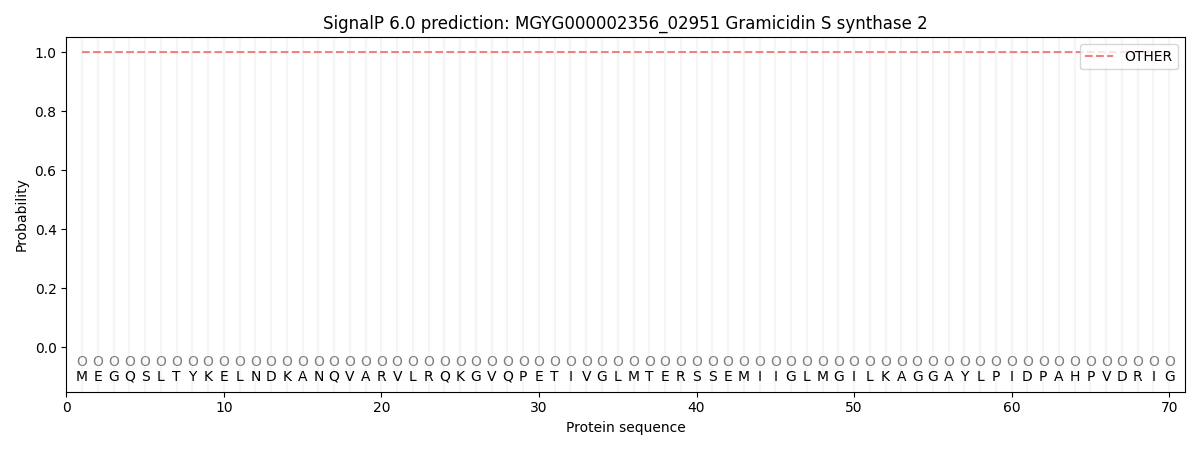
| Other | SP_Sec_SPI | LIPO_Sec_SPII | TAT_Tat_SPI | TATLIP_Sec_SPII | PILIN_Sec_SPIII |
|---|---|---|---|---|---|
| 1.000074 | 0.000000 | 0.000000 | 0.000000 | 0.000000 | 0.000000 |