

You are browsing environment: HUMAN GUT
CAZyme Information: MGYG000002872_01955
You are here: Home > Sequence: MGYG000002872_01955
Basic Information |
Genomic context |
Full Sequence |
Enzyme annotations |
CAZy signature domains |
CDD domains |
CAZyme hits |
PDB hits |
Swiss-Prot hits |
SignalP and Lipop annotations |
TMHMM annotations
Basic Information help
| Species | UMGS874 sp900546315 | |||||||||||
|---|---|---|---|---|---|---|---|---|---|---|---|---|
| Lineage | Bacteria; Firmicutes_A; Clostridia; Oscillospirales; CAG-272; UMGS874; UMGS874 sp900546315 | |||||||||||
| CAZyme ID | MGYG000002872_01955 | |||||||||||
| CAZy Family | GH116 | |||||||||||
| CAZyme Description | hypothetical protein | |||||||||||
| CAZyme Property |
|
|||||||||||
| Genome Property |
|
|||||||||||
| Gene Location | Start: 11578; End: 14085 Strand: + | |||||||||||
CAZyme Signature Domains help
| Family | Start | End | Evalue | family coverage |
|---|---|---|---|---|
| GH116 | 440 | 734 | 3.9e-55 | 0.7245179063360881 |
CDD Domains download full data without filtering help
| Cdd ID | Domain | E-Value | qStart | qEnd | sStart | sEnd | Domain Description |
|---|---|---|---|---|---|---|---|
| pfam12215 | Glyco_hydr_116N | 2.22e-54 | 16 | 322 | 2 | 309 | beta-glucosidase 2, glycosyl-hydrolase family 116 N-term. This domain is found in bacteria, archaea and eukaryotes. This domain is typically between 320 to 354 amino acids in length. This domain is found associated with pfam04685. It is found just after the extreme N-terminus. The N-terminal is thought to be the luminal domain while the C terminal is the cytosolic domain. The catalytic domain of GBA-2 is unknown. The primary catabolic pathway for glucosylceramide is catalysis by the lysosomal enzyme glucocerebrosidase. In higher eukaryotes, glucosylceramide is the precursor of glycosphingolipids, a complex group of ubiquitous membrane lipids. Mutations in the human protein cause motor-neurone defects in hereditary spastic paraplegia. The catalytic nucleophile, identified in UniProtKB:Q97YG8_SULSO, is a glutamine-335 in the downstream family pfam04685. |
| COG4354 | COG4354 | 3.64e-42 | 17 | 742 | 16 | 721 | Uncharacterized protein, contains GBA2_N and DUF608 domains [Function unknown]. |
| pfam04685 | DUF608 | 1.97e-40 | 387 | 734 | 19 | 362 | Glycosyl-hydrolase family 116, catalytic region. This represents a family of archaeal, bacterial and eukaryotic glycosyl hydrolases, that belong to superfamily GH116. The primary catabolic pathway for glucosylceramide is catalysis by the lysosomal enzyme glucocerebrosidase. In higher eukaryotes, glucosylceramide is the precursor of glycosphingolipids, a complex group of ubiquitous membrane lipids. Mutations in the human protein cause motor-neurone defects in hereditary spastic paraplegia. The catalytic nucleophile, identified in UniProtKB:Q97YG8_SULSO, is a glutamine-335, with the likely acid/base at Asp-442 and the aspartates at Asp-406 and Asp-458 residues also playing a role in the catalysis of glucosides and xylosides that are beta-bound to hydrophobic groups. The family is defined as GH116, which presently includes enzymes with beta-glucosidase, EC:3.2.1.21, beta-xylosidase, EC:3.2.1.37, and glucocerebrosidase EC:3.2.1.45 activity. |
| pfam17389 | Bac_rhamnosid6H | 1.16e-05 | 415 | 560 | 77 | 215 | Bacterial alpha-L-rhamnosidase 6 hairpin glycosidase domain. This family consists of bacterial rhamnosidase A and B enzymes. L-Rhamnose is abundant in biomass as a common constituent of glycolipids and glycosides, such as plant pigments, pectic polysaccharides, gums or biosurfactants. Some rhamnosides are important bioactive compounds. For example, terpenyl glycosides, the glycosidic precursor of aromatic terpenoids, act as important flavouring substances in grapes. Other rhamnosides act as cytotoxic rhamnosylated terpenoids, as signal substances in plants or play a role in the antigenicity of pathogenic bacteria. |
CAZyme Hits help
| Hit ID | E-Value | Query Start | Query End | Hit Start | Hit End |
|---|---|---|---|---|---|
| AZN43107.1 | 1.37e-293 | 6 | 823 | 5 | 847 |
| ANE45793.1 | 6.12e-293 | 3 | 797 | 2 | 822 |
| QUH30377.1 | 1.27e-291 | 6 | 831 | 4 | 856 |
| QHT59778.1 | 2.46e-291 | 6 | 823 | 5 | 847 |
| AEE95836.1 | 9.79e-290 | 6 | 799 | 8 | 835 |
PDB Hits download full data without filtering help
| Hit ID | E-Value | Query Start | Query End | Hit Start | Hit End | Description |
|---|---|---|---|---|---|---|
| 7DKW_A | 9.33e-25 | 17 | 704 | 59 | 744 | ChainA, beta-glucosidase [Thermoanaerobacterium xylanolyticum LX-11],7DKW_B Chain B, beta-glucosidase [Thermoanaerobacterium xylanolyticum LX-11],7DKX_A Chain A, beta-glucosidase [Thermoanaerobacterium xylanolyticum LX-11],7DKY_A Chain A, beta-glucosidase [Thermoanaerobacterium xylanolyticum LX-11] |
| 7W2V_A | 3.99e-24 | 17 | 729 | 102 | 817 | ChainA, Glucosylceramidase [Thermoanaerobacterium xylanolyticum LX-11] |
| 7DKS_A | 4.93e-24 | 17 | 704 | 59 | 744 | ChainA, beta-glucosidase [Thermoanaerobacterium xylanolyticum LX-11],7DKT_A Chain A, beta-glucosidase [Thermoanaerobacterium xylanolyticum LX-11],7DKU_A Chain A, beta-glucosidase [Thermoanaerobacterium xylanolyticum LX-11],7DKV_A Chain A, beta-glucosidase [Thermoanaerobacterium xylanolyticum LX-11] |
| 5FJS_A | 8.40e-24 | 17 | 704 | 55 | 740 | Bacterialbeta-glucosidase reveals the structural and functional basis of genetic defects in human glucocerebrosidase 2 (GBA2) [Thermoanaerobacterium xylanolyticum LX-11],5FJS_B Bacterial beta-glucosidase reveals the structural and functional basis of genetic defects in human glucocerebrosidase 2 (GBA2) [Thermoanaerobacterium xylanolyticum LX-11],5O0S_A Crystal structure of txGH116 (beta-glucosidase from Thermoanaerobacterium xylolyticum) in complex with unreacted beta Cyclophellitol Cyclosulfate probe ME711 [Thermoanaerobacterium xylanolyticum LX-11] |
| 5NPF_A | 8.56e-24 | 17 | 704 | 58 | 743 | Crystalstructure of txGH116 (beta-glucosidase from Thermoanaerobacterium xylolyticum) in complex with beta Cyclophellitol Cyclosulfate probe ME594 [Thermoanaerobacterium xylanolyticum] |
Swiss-Prot Hits help
SignalP and Lipop Annotations help
This protein is predicted as OTHER
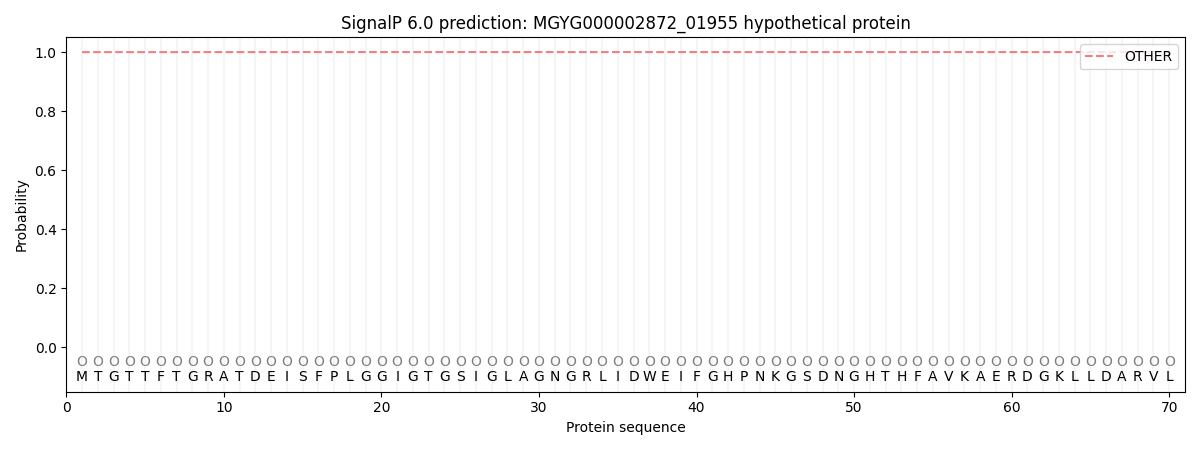
| Other | SP_Sec_SPI | LIPO_Sec_SPII | TAT_Tat_SPI | TATLIP_Sec_SPII | PILIN_Sec_SPIII |
|---|---|---|---|---|---|
| 0.999979 | 0.000087 | 0.000000 | 0.000000 | 0.000000 | 0.000000 |