
You are browsing environment: HUMAN GUT
CAZyme Information: MGYG000003584_00411
You are here: Home > Sequence: MGYG000003584_00411
Basic Information |
Genomic context |
Full Sequence |
Enzyme annotations |
CAZy signature domains |
CDD domains |
CAZyme hits |
PDB hits |
Swiss-Prot hits |
SignalP and Lipop annotations |
TMHMM annotations
Basic Information help
| Species | HGM11412 sp900770185 | |||||||||||
|---|---|---|---|---|---|---|---|---|---|---|---|---|
| Lineage | Bacteria; Firmicutes_A; Clostridia_A; Christensenellales; Borkfalkiaceae; HGM11412; HGM11412 sp900770185 | |||||||||||
| CAZyme ID | MGYG000003584_00411 | |||||||||||
| CAZy Family | GH57 | |||||||||||
| CAZyme Description | hypothetical protein | |||||||||||
| CAZyme Property |
|
|||||||||||
| Genome Property |
|
|||||||||||
| Gene Location | Start: 1355; End: 2740 Strand: + | |||||||||||
CAZyme Signature Domains help
| Family | Start | End | Evalue | family coverage |
|---|---|---|---|---|
| GH57 | 26 | 342 | 2e-22 | 0.7154046997389034 |
CDD Domains download full data without filtering help
| Cdd ID | Domain | E-Value | qStart | qEnd | sStart | sEnd | Domain Description |
|---|---|---|---|---|---|---|---|
| cd10794 | GH57N_PfGalA_like | 3.35e-84 | 6 | 342 | 1 | 305 | N-terminal catalytic domain of alpha-galactosidase; glycoside hydrolase family 57 (GH57). Alpha-galactosidases (GalA, EC 3.2.1.22) catalyze the hydrolysis of alpha-1,6-linked galactose residues from oligosaccharides and polymeric galactomannans. Based on sequence similarity, the majority of eukaryotic and bacterial GalAs have been classified into glycoside hydrolase family GH27, GH36, and GH4, respectively. This subfamily is represented by a novel type of GalA from Pyrococcus furiosus (PfGalA), which belongs to the GH57 family. PfGalA is an extremely thermo-active and thermostable GalA that functions as a bacterial-like GalA, however, without the capacity to hydrolyze polysaccharides. It specifically catalyzes the hydrolysis of para-nitrophenyl-alpha-galactopyranoside, and to some extent that of melibiose and raffinose. PfGalA has a pH optimum between 5.0-5.5. |
| cd01022 | GH57N_like | 6.81e-13 | 6 | 149 | 1 | 166 | N-terminal catalytic domain of heat stable retaining glycoside hydrolase family 57. Glycoside hydrolase family 57(GH57) is a chiefly prokaryotic family with the majority of thermostable enzymes coming from extremophiles (many of these are archaeal hyperthermophiles), which exhibit the enzyme specificities of alpha-amylase (EC 3.2.1.1), 4-alpha-glucanotransferase (EC 2.4.1.25), amylopullulanase (EC 3.2.1.1/41), and alpha-galactosidase (EC 3.2.1.22). This family also includes many hypothetical proteins with uncharacterized activity and specificity. GH57s cleave alpha-glycosidic bonds by employing a retaining mechanism, which involves a glycosyl-enzyme intermediate, allowing transglycosylation. |
| pfam03065 | Glyco_hydro_57 | 9.77e-11 | 1 | 145 | 26 | 172 | Glycosyl hydrolase family 57. This family includes alpha-amylase (EC:3.2.1.1), 4--glucanotransferase (EC:2.4.1.-) and amylopullulanase enzymes. |
| cd10793 | GH57N_TLGT_like | 1.09e-10 | 26 | 152 | 22 | 148 | N-terminal catalytic domain of 4-alpha-glucanotransferase; glycoside hydrolase family 57 (GH57). 4-alpha-glucanotransferase (TLGT, EC 2.4.1.25) plays a key role in the maltose metabolism. It catalyzes the disproportionation of amylose and the formation of large cyclic alpha-1,4-glucan (cycloamylose) from linear amylose. TLGT functions as a homodimer. Each monomer is composed of two domains, an N-terminal catalytic domain with a (beta/alpha)7 barrel fold and a C-terminal domain with a twisted beta-sandwich fold. Some family members have been designated as alpha-amylases, such as the heat-stable eubacterial amylase from Dictyoglomus thermophilum (DtAmyA) and the extremely thermostable archaeal amylase from Pyrococcus furiosus(PfAmyA). However, both of these proteins are 4-alpha-glucanotransferases. DtAmyA was shown to have transglycosylating activity and PfAmyA exhibits 4-alpha-glucanotransferase activity. |
| cd10795 | GH57N_MJA1_like | 1.65e-08 | 26 | 145 | 42 | 166 | N-terminal catalytic domain of a thermoactive alpha-amylase from Methanococcus jannaschii and similar proteins; glycoside hydrolase family 57 (GH57). The subfamily is represented by a thermostable alpha-amylase (MJA1, EC 3.2.1.1) encoded from the hyperthermophilic archaeon Methanococcus jannaschii locus, M J1611. MJA1 has a broad pH optimum 5.0-8.0. It exhibits extremely thermophilic alpha-amylase activity that catalyzes the hydrolysis of large sugar polymers with alpha-l,6 and alpha-l,4 linkages, and yields products including glucose polymers of 1-7 units. MJ1611 also encodes another alpha-amylase with catalytic features distinct from MJA1, which belongs to glycoside hydrolase family 13 (GH-13), and is not included here. This subfamily also includes many uncharacterized proteins found in bacteria and archaea. |
CAZyme Hits help
| Hit ID | E-Value | Query Start | Query End | Hit Start | Hit End |
|---|---|---|---|---|---|
| AVM45997.1 | 4.11e-220 | 4 | 461 | 6 | 459 |
| AHF90539.1 | 3.60e-192 | 6 | 461 | 7 | 463 |
| QDT00377.1 | 1.81e-43 | 10 | 402 | 8 | 393 |
| QAZ69632.1 | 1.69e-14 | 4 | 148 | 2 | 146 |
| QWC98984.1 | 2.63e-11 | 10 | 145 | 9 | 144 |
Swiss-Prot Hits download full data without filtering help
| Hit ID | E-Value | Query Start | Query End | Hit Start | Hit End | Description |
|---|---|---|---|---|---|---|
| O57932 | 6.66e-07 | 25 | 209 | 21 | 214 | Alpha-amylase OS=Pyrococcus horikoshii (strain ATCC 700860 / DSM 12428 / JCM 9974 / NBRC 100139 / OT-3) OX=70601 GN=amyA PE=3 SV=1 |
SignalP and Lipop Annotations help
This protein is predicted as OTHER
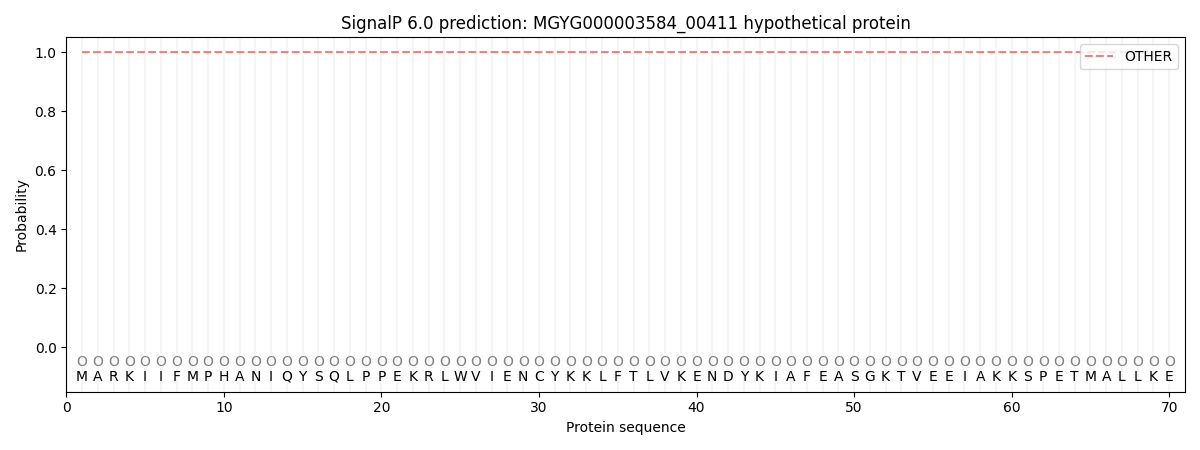
| Other | SP_Sec_SPI | LIPO_Sec_SPII | TAT_Tat_SPI | TATLIP_Sec_SPII | PILIN_Sec_SPIII |
|---|---|---|---|---|---|
| 1.000058 | 0.000000 | 0.000000 | 0.000000 | 0.000000 | 0.000000 |