

You are browsing environment: HUMAN GUT
CAZyme Information: MGYG000003671_00631
You are here: Home > Sequence: MGYG000003671_00631
Basic Information |
Genomic context |
Full Sequence |
Enzyme annotations |
CAZy signature domains |
CDD domains |
CAZyme hits |
PDB hits |
Swiss-Prot hits |
SignalP and Lipop annotations |
TMHMM annotations
Basic Information help
| Species | HGM10818 sp900772445 | |||||||||||
|---|---|---|---|---|---|---|---|---|---|---|---|---|
| Lineage | Bacteria; Firmicutes; Bacilli; RF39; UBA660; HGM10818; HGM10818 sp900772445 | |||||||||||
| CAZyme ID | MGYG000003671_00631 | |||||||||||
| CAZy Family | GT2 | |||||||||||
| CAZyme Description | hypothetical protein | |||||||||||
| CAZyme Property |
|
|||||||||||
| Genome Property |
|
|||||||||||
| Gene Location | Start: 7540; End: 8619 Strand: + | |||||||||||
CDD Domains download full data without filtering help
| Cdd ID | Domain | E-Value | qStart | qEnd | sStart | sEnd | Domain Description |
|---|---|---|---|---|---|---|---|
| cd02511 | Beta4Glucosyltransferase | 1.84e-09 | 4 | 170 | 1 | 165 | UDP-glucose LOS-beta-1,4 glucosyltransferase is required for biosynthesis of lipooligosaccharide. UDP-glucose: lipooligosaccharide (LOS) beta-1-4-glucosyltransferase catalyzes the addition of the first residue, glucose, of the lacto-N-neotetrase structure to HepI of the LOS inner core. LOS is the major constituent of the outer leaflet of the outer membrane of gram-positive bacteria. It consists of a short oligosaccharide chain of variable composition (alpha chain) attached to a branched inner core which is lined in turn to lipid A. Beta 1,4 glucosyltransferase is required to attach the alpha chain to the inner core. |
| sd00006 | TPR | 1.09e-06 | 239 | 340 | 7 | 97 | Tetratricopeptide repeat. The Tetratricopeptide repeat (TPR) typically contains 34 amino acids and is found in a variety of organisms including bacteria, cyanobacteria, yeast, fungi, plants, and humans. It is present in a variety of proteins including those involved in chaperone, cell-cycle, transcription, and protein transport complexes. The number of TPR motifs varies among proteins. Those containing 5-6 tandem repeats generate a right-handed helical structure with an amphipathic channel that is thought to accommodate an alpha-helix of a target protein. It has been proposed that TPR proteins preferentially interact with WD-40 repeat proteins, but in many instances several TPR-proteins seem to aggregate to multi-protein complexes. |
| sd00006 | TPR | 1.14e-06 | 197 | 295 | 4 | 97 | Tetratricopeptide repeat. The Tetratricopeptide repeat (TPR) typically contains 34 amino acids and is found in a variety of organisms including bacteria, cyanobacteria, yeast, fungi, plants, and humans. It is present in a variety of proteins including those involved in chaperone, cell-cycle, transcription, and protein transport complexes. The number of TPR motifs varies among proteins. Those containing 5-6 tandem repeats generate a right-handed helical structure with an amphipathic channel that is thought to accommodate an alpha-helix of a target protein. It has been proposed that TPR proteins preferentially interact with WD-40 repeat proteins, but in many instances several TPR-proteins seem to aggregate to multi-protein complexes. |
| COG0463 | WcaA | 8.01e-06 | 1 | 302 | 1 | 291 | Glycosyltransferase involved in cell wall bisynthesis [Cell wall/membrane/envelope biogenesis]. |
| sd00006 | TPR | 4.86e-05 | 268 | 352 | 2 | 75 | Tetratricopeptide repeat. The Tetratricopeptide repeat (TPR) typically contains 34 amino acids and is found in a variety of organisms including bacteria, cyanobacteria, yeast, fungi, plants, and humans. It is present in a variety of proteins including those involved in chaperone, cell-cycle, transcription, and protein transport complexes. The number of TPR motifs varies among proteins. Those containing 5-6 tandem repeats generate a right-handed helical structure with an amphipathic channel that is thought to accommodate an alpha-helix of a target protein. It has been proposed that TPR proteins preferentially interact with WD-40 repeat proteins, but in many instances several TPR-proteins seem to aggregate to multi-protein complexes. |
CAZyme Hits help
| Hit ID | E-Value | Query Start | Query End | Hit Start | Hit End |
|---|---|---|---|---|---|
| QOX65321.1 | 2.43e-143 | 3 | 357 | 4 | 358 |
| ACV63878.1 | 9.38e-136 | 2 | 358 | 3 | 358 |
| AQS58819.1 | 7.91e-133 | 4 | 356 | 5 | 357 |
| QIB69610.1 | 4.53e-132 | 2 | 359 | 3 | 360 |
| AQS58818.1 | 6.92e-131 | 4 | 356 | 5 | 357 |
Swiss-Prot Hits help
SignalP and Lipop Annotations help
This protein is predicted as OTHER
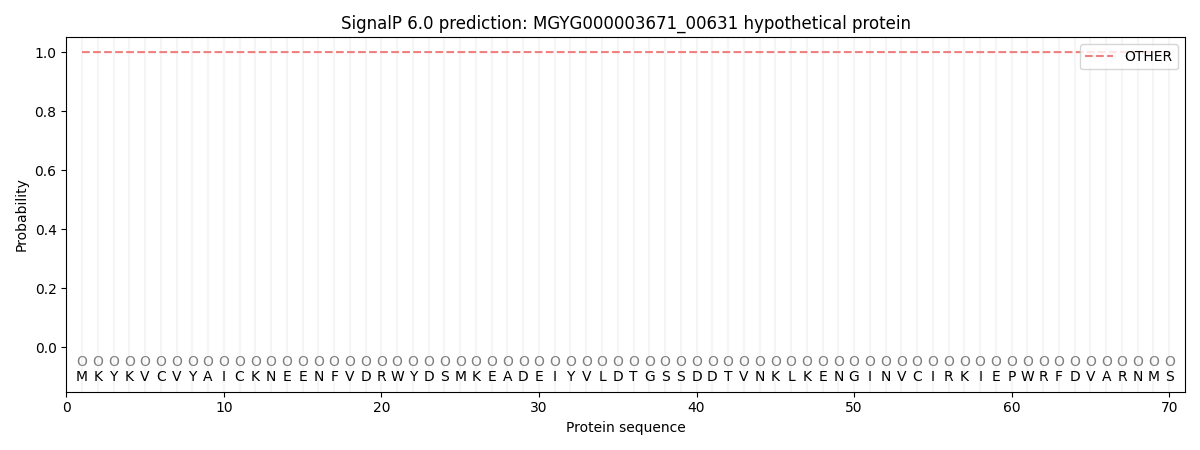
| Other | SP_Sec_SPI | LIPO_Sec_SPII | TAT_Tat_SPI | TATLIP_Sec_SPII | PILIN_Sec_SPIII |
|---|---|---|---|---|---|
| 1.000057 | 0.000000 | 0.000000 | 0.000000 | 0.000000 | 0.000000 |