

You are browsing environment: HUMAN GUT
CAZyme Information: MGYG000003687_02222
You are here: Home > Sequence: MGYG000003687_02222
Basic Information |
Genomic context |
Full Sequence |
Enzyme annotations |
CAZy signature domains |
CDD domains |
CAZyme hits |
PDB hits |
Swiss-Prot hits |
SignalP and Lipop annotations |
TMHMM annotations
Basic Information help
| Species | Paenibacillus polymyxa | |||||||||||
|---|---|---|---|---|---|---|---|---|---|---|---|---|
| Lineage | Bacteria; Firmicutes; Bacilli; Paenibacillales; Paenibacillaceae; Paenibacillus; Paenibacillus polymyxa | |||||||||||
| CAZyme ID | MGYG000003687_02222 | |||||||||||
| CAZy Family | GT2 | |||||||||||
| CAZyme Description | Gramicidin S synthase 2 | |||||||||||
| CAZyme Property |
|
|||||||||||
| Genome Property |
|
|||||||||||
| Gene Location | Start: 84219; End: 92768 Strand: + | |||||||||||
CDD Domains download full data without filtering help
| Cdd ID | Domain | E-Value | qStart | qEnd | sStart | sEnd | Domain Description |
|---|---|---|---|---|---|---|---|
| cd19543 | DCL_NRPS | 0.0 | 272 | 696 | 1 | 423 | DCL-type Condensation domain of nonribosomal peptide synthetases (NRPSs), which catalyzes the condensation between a D-aminoacyl/peptidyl-PCP donor and a L-aminoacyl-PCP acceptor. The DCL-type Condensation (C) domain catalyzes the condensation between a D-aminoacyl/peptidyl-PCP donor and a L-aminoacyl-PCP acceptor. This domain is D-specific for the peptidyl donor and L-specific for the aminoacyl acceptor ((D)C(L)); this is in contrast with the standard LCL domains which catalyze peptide bond formation between two L-amino acids, and the restriction of ribosomes to use only L-amino acids. C domains of nonribosomal peptide synthetases (NRPSs) catalyze peptide bond formation within (usually) large multi-modular enzymatic complexes. NRPS can use a large variety of acyl monomers (approximately 500 different possible monomer substrates as opposed to the 20 standard amino acids in ribosomal protein synthesis) to construct bioactive secondary metabolites of 2 to 18 units long (with various activities such as antibiotic, antifungal, antitumor and immunosuppression). There are various subtypes of C-domains in addition to the LCL- and DCL-types such as starter C-domains which acylate the first amino acid with a beta-hydroxy carboxylic acid, and heterocyclization (Cyc) domains which catalyze both peptide bond formation and cyclization of Cys, Ser, or Thr residues. Typically, an NRPS module consists of an adenylation domain, a peptidyl carrier protein (PCP) domain (also known as thiolation (T) domain) and a C-domain. NRPS modules may also include specialized domains such as the terminal-module thioesterase (Te) domain that releases the product via hydrolysis or macrocyclization and any of various C-domain family members such as the epimerization (E) domain, the ester-bond forming C-domain, dual E/C (epimerization and condensation) domains, and the X-domain. C-domains typically have a conserved HHxxxD motif at the active site; mutations in this motif can abolish or diminish condensation activity. |
| cd19531 | LCL_NRPS-like | 0.0 | 1322 | 1751 | 2 | 427 | LCL-type Condensation (C) domain of non-ribosomal peptide synthetases(NRPSs) and similar domains including the C-domain of SgcC5, a free-standing NRPS with both ester- and amide- bond forming activity. LCL-type Condensation (C) domains catalyze peptide bond formation between two L-amino acids, ((L)C(L)). C-domains of NRPSs catalyze peptide bond formation within (usually) large multi-modular enzymatic complexes. NRPS can use a large variety of acyl monomers (approximately 500 different possible monomer substrates as opposed to the 20 standard amino acids in ribosomal protein synthesis) to construct bioactive secondary metabolites of 2 to 18 units long (with various activities such as antibiotic, antifungal, antitumor and immunosuppression). In addition to the LCL-type, there are various subtypes of C-domains such as the DCL-type which links an L-amino acid to the D-amino acid at the end of a growing peptide, starter C-domains which acylate the first amino acid with a beta-hydroxy carboxylic acid, and heterocyclization (Cyc) domains which catalyze both peptide bond formation and cyclization of Cys, Ser, or Thr residues. Typically, an NRPS module consists of an adenylation domain, a peptidyl carrier protein (PCP) domain (also known as thiolation (T) domain) and a C-domain. NRPS modules may also include specialized domains such as the terminal-module thioesterase (Te) domain that releases the product via hydrolysis or macrocyclization and any of various C-domain family members such as the epimerization (E) domain, the ester-bond forming C-domain, dual E/C (epimerization and condensation) domains, and the X-domain. Streptomyces globisporus SgcC5 is a free-standing NRPS condensation enzyme (rather than a modular NRPS), which catalyzes the condensation between the SgcC2-tethered (S)-3-chloro-5-hydroxy-beta-tyrosine and (R)-1phenyl-1,2-ethanediol, forming an ester bond, during the synthesis of the chromoprotein enediyne antitumor antibiotic C-1027. It has some acceptor substrate promiscuity as it has been shown to also catalyze the formation of an amide bond between SgcC2-tethered (S)-3-chloro-5-hydroxy-beta-tyrosine and a mimic of the enediyne core acceptor substrate having an amine at its C-2 position. C-domains typically have a conserved HHxxxD motif at the active site; mutations in this motif can abolish or diminish condensation activity. An HHxx[SAG]DGxSx(6)[ED] motif is characteristic of LCL-type C-domains. |
| cd12117 | A_NRPS_Srf_like | 0.0 | 734 | 1216 | 2 | 483 | The adenylation domain of nonribosomal peptide synthetases (NRPS), including Bacillus subtilis termination module Surfactin (SrfA-C). The adenylation (A) domain of NRPS recognizes a specific amino acid or hydroxy acid and activates it as an (amino) acyl adenylate by hydrolysis of ATP. The activated acyl moiety then forms a thioester to the enzyme-bound cofactor phosphopantetheine of a peptidyl carrier protein domain. NRPSs are large multifunctional enzymes which synthesize many therapeutically useful peptides in bacteria and fungi via a template-directed, nucleic acid independent nonribosomal mechanism. These natural products include antibiotics, immunosuppressants, plant and animal toxins, and enzyme inhibitors. NRPS has a distinct modular structure in which each module is responsible for the recognition, activation, and, in some cases, modification of a single amino acid residue of the final peptide product. The modules can be subdivided into domains that catalyze specific biochemical reactions. This family includes the adenylation domain of the Bacillus subtilis termination module (Surfactin domain, SrfA-C) which recognizes a specific amino acid building block, which is then activated and transferred to the terminal thiol of the 4'-phosphopantetheine (Ppan) arm of the downstream peptidyl carrier protein (PCP) domain. |
| PRK12316 | PRK12316 | 0.0 | 3 | 1308 | 3834 | 5145 | peptide synthase; Provisional |
| cd19531 | LCL_NRPS-like | 0.0 | 2410 | 2822 | 1 | 427 | LCL-type Condensation (C) domain of non-ribosomal peptide synthetases(NRPSs) and similar domains including the C-domain of SgcC5, a free-standing NRPS with both ester- and amide- bond forming activity. LCL-type Condensation (C) domains catalyze peptide bond formation between two L-amino acids, ((L)C(L)). C-domains of NRPSs catalyze peptide bond formation within (usually) large multi-modular enzymatic complexes. NRPS can use a large variety of acyl monomers (approximately 500 different possible monomer substrates as opposed to the 20 standard amino acids in ribosomal protein synthesis) to construct bioactive secondary metabolites of 2 to 18 units long (with various activities such as antibiotic, antifungal, antitumor and immunosuppression). In addition to the LCL-type, there are various subtypes of C-domains such as the DCL-type which links an L-amino acid to the D-amino acid at the end of a growing peptide, starter C-domains which acylate the first amino acid with a beta-hydroxy carboxylic acid, and heterocyclization (Cyc) domains which catalyze both peptide bond formation and cyclization of Cys, Ser, or Thr residues. Typically, an NRPS module consists of an adenylation domain, a peptidyl carrier protein (PCP) domain (also known as thiolation (T) domain) and a C-domain. NRPS modules may also include specialized domains such as the terminal-module thioesterase (Te) domain that releases the product via hydrolysis or macrocyclization and any of various C-domain family members such as the epimerization (E) domain, the ester-bond forming C-domain, dual E/C (epimerization and condensation) domains, and the X-domain. Streptomyces globisporus SgcC5 is a free-standing NRPS condensation enzyme (rather than a modular NRPS), which catalyzes the condensation between the SgcC2-tethered (S)-3-chloro-5-hydroxy-beta-tyrosine and (R)-1phenyl-1,2-ethanediol, forming an ester bond, during the synthesis of the chromoprotein enediyne antitumor antibiotic C-1027. It has some acceptor substrate promiscuity as it has been shown to also catalyze the formation of an amide bond between SgcC2-tethered (S)-3-chloro-5-hydroxy-beta-tyrosine and a mimic of the enediyne core acceptor substrate having an amine at its C-2 position. C-domains typically have a conserved HHxxxD motif at the active site; mutations in this motif can abolish or diminish condensation activity. An HHxx[SAG]DGxSx(6)[ED] motif is characteristic of LCL-type C-domains. |
CAZyme Hits help
| Hit ID | E-Value | Query Start | Query End | Hit Start | Hit End |
|---|---|---|---|---|---|
| QND46664.1 | 0.0 | 231 | 2436 | 518 | 2702 |
| BAY90071.1 | 1.61e-197 | 365 | 2838 | 228 | 2680 |
| ACX49739.1 | 6.41e-197 | 275 | 2071 | 12 | 1847 |
| BAZ00088.1 | 2.26e-190 | 365 | 2829 | 229 | 2680 |
| BAZ75991.1 | 2.26e-190 | 365 | 2829 | 229 | 2680 |
PDB Hits download full data without filtering help
| Hit ID | E-Value | Query Start | Query End | Hit Start | Hit End | Description |
|---|---|---|---|---|---|---|
| 6MFY_A | 0.0 | 724 | 2309 | 200 | 1716 | Crystalstructure of a 5-domain construct of LgrA in the substrate donation state [Brevibacillus parabrevis],6MG0_A Crystal structure of a 5-domain construct of LgrA in the thiolation state [Brevibacillus parabrevis],6MG0_B Crystal structure of a 5-domain construct of LgrA in the thiolation state [Brevibacillus parabrevis] |
| 6MFZ_A | 0.0 | 724 | 2411 | 200 | 1813 | Crystalstructure of dimodular LgrA in a condensation state [Brevibacillus parabrevis],6MFZ_B Crystal structure of dimodular LgrA in a condensation state [Brevibacillus parabrevis] |
| 2VSQ_A | 5.69e-235 | 268 | 1356 | 8 | 1114 | Structureof surfactin A synthetase C (SrfA-C), a nonribosomal peptide synthetase termination module [Bacillus subtilis] |
| 5U89_A | 2.01e-209 | 1764 | 2836 | 5 | 1066 | Crystalstructure of a cross-module fragment from the dimodular NRPS DhbF [Geobacillus sp. Y4.1MC1] |
| 6MFW_A | 6.98e-206 | 724 | 1765 | 200 | 1205 | Crystalstructure of a 4-domain construct of LgrA in the substrate donation state [Brevibacillus parabrevis] |
Swiss-Prot Hits download full data without filtering help
| Hit ID | E-Value | Query Start | Query End | Hit Start | Hit End | Description |
|---|---|---|---|---|---|---|
| P45745 | 0.0 | 273 | 2389 | 9 | 2105 | Dimodular nonribosomal peptide synthase OS=Bacillus subtilis (strain 168) OX=224308 GN=dhbF PE=1 SV=4 |
| Q70LM4 | 0.0 | 5 | 2391 | 2313 | 4672 | Linear gramicidin synthase subunit D OS=Brevibacillus parabrevis OX=54914 GN=lgrD PE=1 SV=1 |
| Q04747 | 0.0 | 269 | 2829 | 6 | 2515 | Surfactin synthase subunit 2 OS=Bacillus subtilis (strain 168) OX=224308 GN=srfAB PE=1 SV=3 |
| P94459 | 0.0 | 267 | 2836 | 5 | 2514 | Plipastatin synthase subunit D OS=Bacillus subtilis (strain 168) OX=224308 GN=ppsD PE=1 SV=2 |
| Q70LM5 | 0.0 | 4 | 2821 | 4915 | 7719 | Linear gramicidin synthase subunit C OS=Brevibacillus parabrevis OX=54914 GN=lgrC PE=3 SV=1 |
SignalP and Lipop Annotations help
This protein is predicted as OTHER
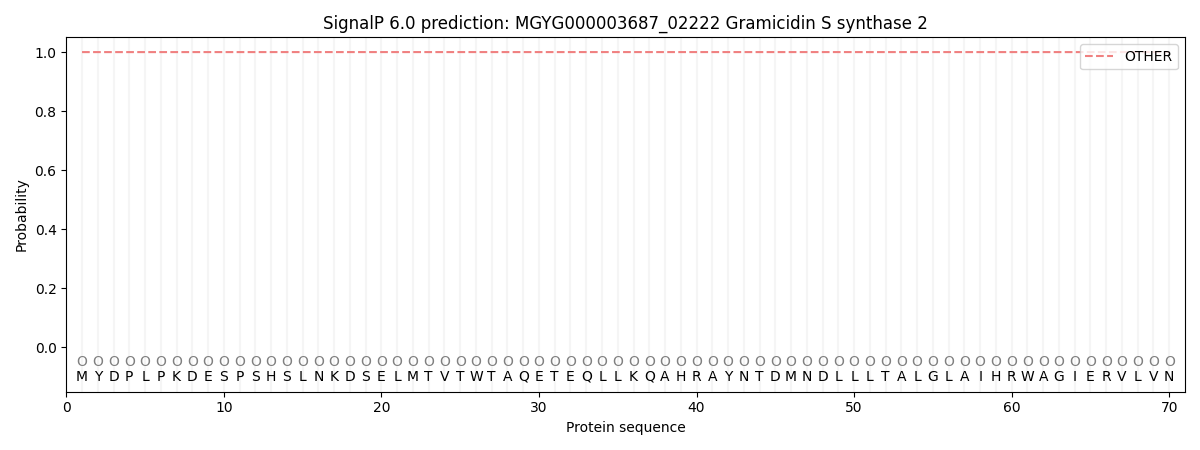
| Other | SP_Sec_SPI | LIPO_Sec_SPII | TAT_Tat_SPI | TATLIP_Sec_SPII | PILIN_Sec_SPIII |
|---|---|---|---|---|---|
| 1.000040 | 0.000000 | 0.000000 | 0.000000 | 0.000000 | 0.000000 |