
You are browsing environment: HUMAN GUT
CAZyme Information: MGYG000004269_02380
You are here: Home > Sequence: MGYG000004269_02380
Basic Information |
Genomic context |
Full Sequence |
Enzyme annotations |
CAZy signature domains |
CDD domains |
CAZyme hits |
PDB hits |
Swiss-Prot hits |
SignalP and Lipop annotations |
TMHMM annotations
Basic Information help
| Species | Blautia_A schinkii | |||||||||||
|---|---|---|---|---|---|---|---|---|---|---|---|---|
| Lineage | Bacteria; Firmicutes_A; Clostridia; Lachnospirales; Lachnospiraceae; Blautia_A; Blautia_A schinkii | |||||||||||
| CAZyme ID | MGYG000004269_02380 | |||||||||||
| CAZy Family | GH13 | |||||||||||
| CAZyme Description | hypothetical protein | |||||||||||
| CAZyme Property |
|
|||||||||||
| Genome Property |
|
|||||||||||
| Gene Location | Start: 1193; End: 3217 Strand: + | |||||||||||
CDD Domains download full data without filtering help
| Cdd ID | Domain | E-Value | qStart | qEnd | sStart | sEnd | Domain Description |
|---|---|---|---|---|---|---|---|
| cd11324 | AmyAc_Amylosucrase | 4.67e-112 | 138 | 596 | 2 | 536 | Alpha amylase catalytic domain found in Amylosucrase. Amylosucrase is a glucosyltransferase that catalyzes the transfer of a D-glucopyranosyl moiety from sucrose onto an acceptor molecule. When the acceptor is another saccharide, only alpha-1,4 linkages are produced. Unlike most amylopolysaccharide synthases, it does not require any alpha-D-glucosyl nucleoside diphosphate substrate. In the presence of glycogen it catalyzes the transfer of a D-glucose moiety onto a glycogen branch, but in its absence, it hydrolyzes sucrose and synthesizes polymers, smaller maltosaccharides, and sucrose isoforms. The Alpha-amylase family comprises the largest family of glycoside hydrolases (GH), with the majority of enzymes acting on starch, glycogen, and related oligo- and polysaccharides. These proteins catalyze the transformation of alpha-1,4 and alpha-1,6 glucosidic linkages with retention of the anomeric center. The protein is described as having 3 domains: A, B, C. A is a (beta/alpha) 8-barrel; B is a loop between the beta 3 strand and alpha 3 helix of A; C is the C-terminal extension characterized by a Greek key. The majority of the enzymes have an active site cleft found between domains A and B where a triad of catalytic residues (Asp, Glu and Asp) performs catalysis. Other members of this family have lost the catalytic activity as in the case of the human 4F2hc, or only have 2 residues that serve as the catalytic nucleophile and the acid/base, such as Thermus A4 beta-galactosidase with 2 Glu residues (GH42) and human alpha-galactosidase with 2 Asp residues (GH31). The family members are quite extensive and include: alpha amylase, maltosyltransferase, cyclodextrin glycotransferase, maltogenic amylase, neopullulanase, isoamylase, 1,4-alpha-D-glucan maltotetrahydrolase, 4-alpha-glucotransferase, oligo-1,6-glucosidase, amylosucrase, sucrose phosphorylase, and amylomaltase. |
| cd11334 | AmyAc_TreS | 2.00e-09 | 333 | 536 | 208 | 374 | Alpha amylase catalytic domain found in Trehalose synthetase. Trehalose synthetase (TreS) catalyzes the reversible interconversion of trehalose and maltose. The enzyme catalyzes the reaction in both directions, but the preferred substrate is maltose. Glucose is formed as a by-product of this reaction. It is believed that the catalytic mechanism may involve the cutting of the incoming disaccharide and transfer of a glucose to an enzyme-bound glucose. This enzyme also catalyzes production of a glucosamine disaccharide from maltose and glucosamine. The Alpha-amylase family comprises the largest family of glycoside hydrolases (GH), with the majority of enzymes acting on starch, glycogen, and related oligo- and polysaccharides. These proteins catalyze the transformation of alpha-1,4 and alpha-1,6 glucosidic linkages with retention of the anomeric center. The protein is described as having 3 domains: A, B, C. A is a (beta/alpha) 8-barrel; B is a loop between the beta 3 strand and alpha 3 helix of A; C is the C-terminal extension characterized by a Greek key. The majority of the enzymes have an active site cleft found between domains A and B where a triad of catalytic residues (Asp, Glu and Asp) performs catalysis. Other members of this family have lost the catalytic activity as in the case of the human 4F2hc, or only have 2 residues that serve as the catalytic nucleophile and the acid/base, such as Thermus A4 beta-galactosidase with 2 Glu residues (GH42) and human alpha-galactosidase with 2 Asp residues (GH31). The family members are quite extensive and include: alpha amylase, maltosyltransferase, cyclodextrin glycotransferase, maltogenic amylase, neopullulanase, isoamylase, 1,4-alpha-D-glucan maltotetrahydrolase, 4-alpha-glucotransferase, oligo-1,6-glucosidase, amylosucrase, sucrose phosphorylase, and amylomaltase. |
| pfam16657 | Malt_amylase_C | 1.70e-05 | 605 | 669 | 6 | 75 | Maltogenic Amylase, C-terminal domain. This is the C-terminal domain of Maltogenic amylase, an enzyme that hydrolyzes starch material. Maltogenic amylases are central to carbohydrate metabolism. |
| cd11338 | AmyAc_CMD | 1.82e-04 | 220 | 279 | 54 | 119 | Alpha amylase catalytic domain found in cyclomaltodextrinases and related proteins. Cyclomaltodextrinase (CDase; EC3.2.1.54), neopullulanase (NPase; EC 3.2.1.135), and maltogenic amylase (MA; EC 3.2.1.133) catalyze the hydrolysis of alpha-(1,4) glycosidic linkages on a number of substrates including cyclomaltodextrins (CDs), pullulan, and starch. These enzymes hydrolyze CDs and starch to maltose and pullulan to panose by cleavage of alpha-1,4 glycosidic bonds whereas alpha-amylases essentially lack activity on CDs and pullulan. They also catalyze transglycosylation of oligosaccharides to the C3-, C4- or C6-hydroxyl groups of various acceptor sugar molecules. Since these proteins are nearly indistinguishable from each other, they are referred to as cyclomaltodextrinases (CMDs). The Alpha-amylase family comprises the largest family of glycoside hydrolases (GH), with the majority of enzymes acting on starch, glycogen, and related oligo- and polysaccharides. These proteins catalyze the transformation of alpha-1,4 and alpha-1,6 glucosidic linkages with retention of the anomeric center. The protein is described as having 3 domains: A, B, C. A is a (beta/alpha) 8-barrel; B is a loop between the beta 3 strand and alpha 3 helix of A; C is the C-terminal extension characterized by a Greek key. The majority of the enzymes have an active site cleft found between domains A and B where a triad of catalytic residues (Asp, Glu and Asp) performs catalysis. Other members of this family have lost the catalytic activity as in the case of the human 4F2hc, or only have 2 residues that serve as the catalytic nucleophile and the acid/base, such as Thermus A4 beta-galactosidase with 2 Glu residues (GH42) and human alpha-galactosidase with 2 Asp residues (GH31). The family members are quite extensive and include: alpha amylase, maltosyltransferase, cyclodextrin glycotransferase, maltogenic amylase, neopullulanase, isoamylase, 1,4-alpha-D-glucan maltotetrahydrolase, 4-alpha-glucotransferase, oligo-1,6-glucosidase, amylosucrase, sucrose phosphorylase, and amylomaltase. |
| COG0810 | TonB | 3.12e-04 | 40 | 147 | 45 | 161 | Periplasmic protein TonB, links inner and outer membranes [Cell wall/membrane/envelope biogenesis]. |
CAZyme Hits help
| Hit ID | E-Value | Query Start | Query End | Hit Start | Hit End |
|---|---|---|---|---|---|
| QCU02723.1 | 0.0 | 1 | 674 | 1 | 694 |
| CBL22253.1 | 2.60e-161 | 138 | 674 | 97 | 709 |
| BDA10513.1 | 4.78e-130 | 138 | 674 | 27 | 640 |
| SNU99921.1 | 1.69e-129 | 138 | 674 | 34 | 649 |
| QIB60618.1 | 7.44e-129 | 138 | 674 | 27 | 640 |
PDB Hits download full data without filtering help
| Hit ID | E-Value | Query Start | Query End | Hit Start | Hit End | Description |
|---|---|---|---|---|---|---|
| 4AYS_A | 1.04e-42 | 133 | 632 | 19 | 600 | TheStructure of Amylosucrase from D. radiodurans [Deinococcus radiodurans] |
| 3UCQ_A | 4.24e-41 | 144 | 633 | 35 | 605 | Crystalstructure of amylosucrase from Deinococcus geothermalis [Deinococcus geothermalis DSM 11300],3UER_A Crystal structure of amylosucrase from Deinococcus geothermalis in complex with turanose [Deinococcus geothermalis DSM 11300] |
| 7ESH_A | 5.78e-41 | 144 | 670 | 36 | 644 | ChainA, amylosucrase [Calidithermus timidus DSM 17022],7ESH_B Chain B, amylosucrase [Calidithermus timidus DSM 17022],7ESH_C Chain C, amylosucrase [Calidithermus timidus DSM 17022],7ESH_D Chain D, amylosucrase [Calidithermus timidus DSM 17022] |
| 4FLR_A | 8.18e-38 | 141 | 632 | 32 | 583 | Crystalstructure of Amylosucrase double mutant A289P-F290L from Neisseria polysaccharea [Neisseria polysaccharea] |
| 4FLQ_A | 1.10e-37 | 141 | 632 | 32 | 583 | Crystalstructure of Amylosucrase double mutant A289P-F290I from Neisseria polysaccharea. [Neisseria polysaccharea] |
Swiss-Prot Hits download full data without filtering help
| Hit ID | E-Value | Query Start | Query End | Hit Start | Hit End | Description |
|---|---|---|---|---|---|---|
| Q9ZEU2 | 9.42e-36 | 141 | 632 | 40 | 591 | Amylosucrase OS=Neisseria polysaccharea OX=489 GN=ams PE=1 SV=1 |
| Q84HD6 | 1.01e-34 | 141 | 632 | 40 | 591 | Amylosucrase OS=Neisseria meningitidis OX=487 GN=ams PE=3 SV=1 |
| A0R6E0 | 6.28e-09 | 200 | 615 | 34 | 483 | Trehalose synthase/amylase TreS OS=Mycolicibacterium smegmatis (strain ATCC 700084 / mc(2)155) OX=246196 GN=treS PE=1 SV=1 |
| P76041 | 7.27e-08 | 330 | 670 | 238 | 558 | Glucosylglycerate phosphorylase OS=Escherichia coli (strain K12) OX=83333 GN=ycjM PE=1 SV=2 |
| P9WQ18 | 9.14e-07 | 194 | 673 | 36 | 585 | Trehalose synthase/amylase TreS OS=Mycobacterium tuberculosis (strain CDC 1551 / Oshkosh) OX=83331 GN=treS PE=3 SV=1 |
SignalP and Lipop Annotations help
This protein is predicted as OTHER
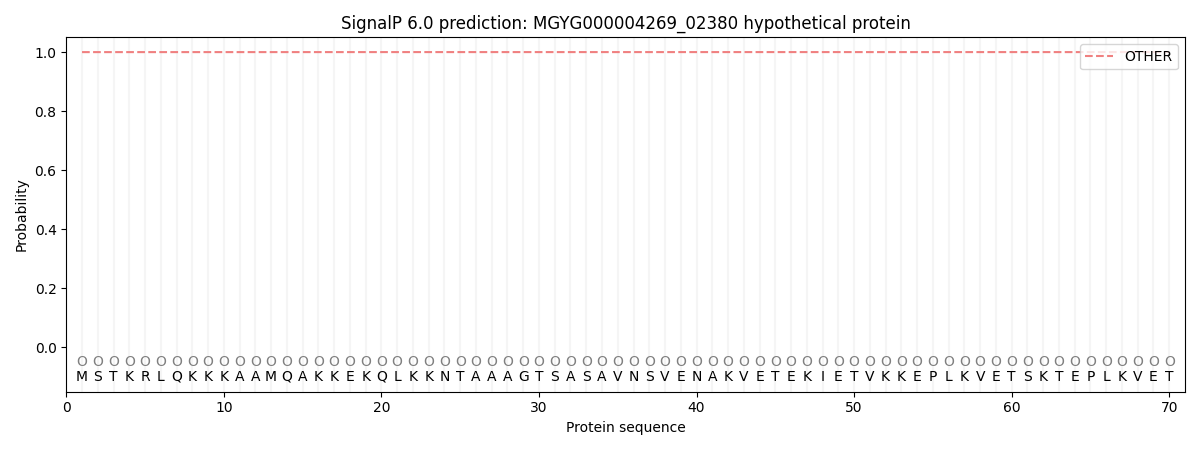
| Other | SP_Sec_SPI | LIPO_Sec_SPII | TAT_Tat_SPI | TATLIP_Sec_SPII | PILIN_Sec_SPIII |
|---|---|---|---|---|---|
| 1.000026 | 0.000000 | 0.000000 | 0.000000 | 0.000000 | 0.000000 |