

You are browsing environment: HUMAN GUT
CAZyme Information: MGYG000004433_00002
You are here: Home > Sequence: MGYG000004433_00002
Basic Information |
Genomic context |
Full Sequence |
Enzyme annotations |
CAZy signature domains |
CDD domains |
CAZyme hits |
PDB hits |
Swiss-Prot hits |
SignalP and Lipop annotations |
TMHMM annotations
Basic Information help
| Species | Bilophila sp900550745 | |||||||||||
|---|---|---|---|---|---|---|---|---|---|---|---|---|
| Lineage | Bacteria; Desulfobacterota; Desulfovibrionia; Desulfovibrionales; Desulfovibrionaceae; Bilophila; Bilophila sp900550745 | |||||||||||
| CAZyme ID | MGYG000004433_00002 | |||||||||||
| CAZy Family | GT2 | |||||||||||
| CAZyme Description | Gramicidin S synthase 2 | |||||||||||
| CAZyme Property |
|
|||||||||||
| Genome Property |
|
|||||||||||
| Gene Location | Start: 1143; End: 7811 Strand: - | |||||||||||
CDD Domains download full data without filtering help
| Cdd ID | Domain | E-Value | qStart | qEnd | sStart | sEnd | Domain Description |
|---|---|---|---|---|---|---|---|
| cd19535 | Cyc_NRPS | 0.0 | 98 | 520 | 1 | 422 | Cyc (heterocyclization) domain of nonribosomal peptide synthetases (NRPSs); belongs to the Condensation-domain family. Cyc (heterocyclization) domains catalyze two separate reactions in the creation of heterocyclized peptide products in nonribosomal peptide synthesis: amide bond formation followed by intramolecular cyclodehydration between a Cys, Ser, or Thr side chain and a carbonyl carbon on the peptide backbone to form a thiazoline, oxazoline, or methyloxazoline ring. Cyc-domains are homologous to standard NRPS Condensation (C) domains. C-domains typically have a conserved HHxxxD motif at the active site; Cyc-domains have an alternative, conserved DxxxxD active site motif, mutation of the aspartate residues in this motif can abolish or diminish condensation activity. NRPS can use a large variety of acyl monomers (approximately 500 different possible monomer substrates as opposed to the 20 standard amino acids in ribosomal protein synthesis) to construct bioactive secondary metabolites of 2 to 18 units long (with various activities such as antibiotic, antifungal, antitumor and immunosuppression). There are various subtypes of C-domains such as the LCL-type which catalyzes peptide bond formation between two L-amino acids, the DCL-type which links an L-amino acid to the D-amino acid at the end of a growing peptide, starter C-domains which acylate the first amino acid with a beta-hydroxy carboxylic acid, and Cyc-domains. Typically, an NRPS module consists of an adenylation domain, a peptidyl carrier protein (PCP) domain (also known as thiolation (T) domain) and a C-domain. NRPS modules may also include specialized domains such as the terminal-module thioesterase (Te) domain that releases the product via hydrolysis or macrocyclization and any of various C-domain family members such as the epimerization (E) domain, the ester-bond forming C-domain, dual E/C (epimerization and condensation) domains, and the X-domain. |
| PRK12467 | PRK12467 | 0.0 | 127 | 2197 | 78 | 2166 | peptide synthase; Provisional |
| cd19535 | Cyc_NRPS | 0.0 | 1160 | 1584 | 1 | 423 | Cyc (heterocyclization) domain of nonribosomal peptide synthetases (NRPSs); belongs to the Condensation-domain family. Cyc (heterocyclization) domains catalyze two separate reactions in the creation of heterocyclized peptide products in nonribosomal peptide synthesis: amide bond formation followed by intramolecular cyclodehydration between a Cys, Ser, or Thr side chain and a carbonyl carbon on the peptide backbone to form a thiazoline, oxazoline, or methyloxazoline ring. Cyc-domains are homologous to standard NRPS Condensation (C) domains. C-domains typically have a conserved HHxxxD motif at the active site; Cyc-domains have an alternative, conserved DxxxxD active site motif, mutation of the aspartate residues in this motif can abolish or diminish condensation activity. NRPS can use a large variety of acyl monomers (approximately 500 different possible monomer substrates as opposed to the 20 standard amino acids in ribosomal protein synthesis) to construct bioactive secondary metabolites of 2 to 18 units long (with various activities such as antibiotic, antifungal, antitumor and immunosuppression). There are various subtypes of C-domains such as the LCL-type which catalyzes peptide bond formation between two L-amino acids, the DCL-type which links an L-amino acid to the D-amino acid at the end of a growing peptide, starter C-domains which acylate the first amino acid with a beta-hydroxy carboxylic acid, and Cyc-domains. Typically, an NRPS module consists of an adenylation domain, a peptidyl carrier protein (PCP) domain (also known as thiolation (T) domain) and a C-domain. NRPS modules may also include specialized domains such as the terminal-module thioesterase (Te) domain that releases the product via hydrolysis or macrocyclization and any of various C-domain family members such as the epimerization (E) domain, the ester-bond forming C-domain, dual E/C (epimerization and condensation) domains, and the X-domain. |
| PRK05691 | PRK05691 | 0.0 | 29 | 2205 | 608 | 2783 | peptide synthase; Validated |
| PRK12316 | PRK12316 | 0.0 | 127 | 2198 | 1583 | 3626 | peptide synthase; Provisional |
CAZyme Hits help
| Hit ID | E-Value | Query Start | Query End | Hit Start | Hit End |
|---|---|---|---|---|---|
| QND46664.1 | 1.35e-218 | 28 | 2206 | 463 | 2674 |
| ACX49739.1 | 4.06e-119 | 248 | 1858 | 164 | 1818 |
| AFZ04852.1 | 6.94e-99 | 1310 | 2196 | 285 | 1185 |
| BAZ00088.1 | 4.16e-89 | 1310 | 2208 | 280 | 1190 |
| BAZ75991.1 | 4.16e-89 | 1310 | 2208 | 280 | 1190 |
PDB Hits download full data without filtering help
| Hit ID | E-Value | Query Start | Query End | Hit Start | Hit End | Description |
|---|---|---|---|---|---|---|
| 7EMY_A | 4.47e-229 | 10 | 1073 | 13 | 1066 | ChainA, Dihydroaeruginoic acid synthetase [Pseudomonas aeruginosa PAO1],7EMY_B Chain B, Dihydroaeruginoic acid synthetase [Pseudomonas aeruginosa PAO1],7EN1_A Chain A, Dihydroaeruginoic acid synthetase [Pseudomonas aeruginosa PAO1],7EN1_B Chain B, Dihydroaeruginoic acid synthetase [Pseudomonas aeruginosa PAO1],7EN2_A Chain A, Dihydroaeruginoic acid synthetase [Pseudomonas aeruginosa PAO1],7EN2_B Chain B, Dihydroaeruginoic acid synthetase [Pseudomonas aeruginosa PAO1] |
| 6LTA_A | 1.09e-225 | 1137 | 2206 | 31 | 1105 | ChainA, Nonribosomal peptide synthetase [Streptomyces sp. Sp080513GE-23],6LTB_A Chain A, Nonribosomal peptide synthetase [Streptomyces sp. Sp080513GE-23],6LTC_A Chain A, Nonribosomal peptide synthetase [Streptomyces sp. Sp080513GE-23],6LTD_A Chain A, Nonribosomal peptide synthetase [Streptomyces sp. Sp080513GE-23],6LTD_B Chain B, Nonribosomal peptide synthetase [Streptomyces sp. Sp080513GE-23] |
| 7LY7_A | 7.06e-223 | 1154 | 2191 | 4 | 1013 | ChainA, BmdB, Bacillamide NRPS [Thermoactinomyces vulgaris] |
| 7LY4_E | 7.28e-223 | 1154 | 2191 | 4 | 1013 | ChainE, BmdB, bacillamide NRPS [Thermoactinomyces vulgaris] |
| 6MFZ_A | 9.55e-194 | 551 | 2194 | 204 | 1797 | Crystalstructure of dimodular LgrA in a condensation state [Brevibacillus parabrevis],6MFZ_B Crystal structure of dimodular LgrA in a condensation state [Brevibacillus parabrevis] |
Swiss-Prot Hits download full data without filtering help
| Hit ID | E-Value | Query Start | Query End | Hit Start | Hit End | Description |
|---|---|---|---|---|---|---|
| P48633 | 1.99e-318 | 27 | 1587 | 41 | 1909 | High-molecular-weight protein 2 OS=Yersinia enterocolitica serotype O:8 / biotype 1B (strain NCTC 13174 / 8081) OX=393305 GN=irp2 PE=3 SV=1 |
| O68006 | 6.98e-300 | 552 | 2194 | 37 | 1651 | Bacitracin synthase 1 OS=Bacillus licheniformis OX=1402 GN=bacA PE=3 SV=1 |
| A0A0H2ZGB9 | 3.01e-230 | 10 | 1073 | 13 | 1066 | Pyochelin synthase PchE OS=Pseudomonas aeruginosa (strain UCBPP-PA14) OX=208963 GN=pchE PE=1 SV=1 |
| G3XCV2 | 1.57e-228 | 10 | 1073 | 13 | 1066 | Pyochelin synthase PchE OS=Pseudomonas aeruginosa (strain ATCC 15692 / DSM 22644 / CIP 104116 / JCM 14847 / LMG 12228 / 1C / PRS 101 / PAO1) OX=208964 GN=pchE PE=1 SV=1 |
| Q7TYQ4 | 2.25e-224 | 12 | 1130 | 15 | 1131 | Phenyloxazoline synthase MbtB OS=Mycobacterium bovis (strain ATCC BAA-935 / AF2122/97) OX=233413 GN=mbtB PE=3 SV=1 |
SignalP and Lipop Annotations help
This protein is predicted as OTHER
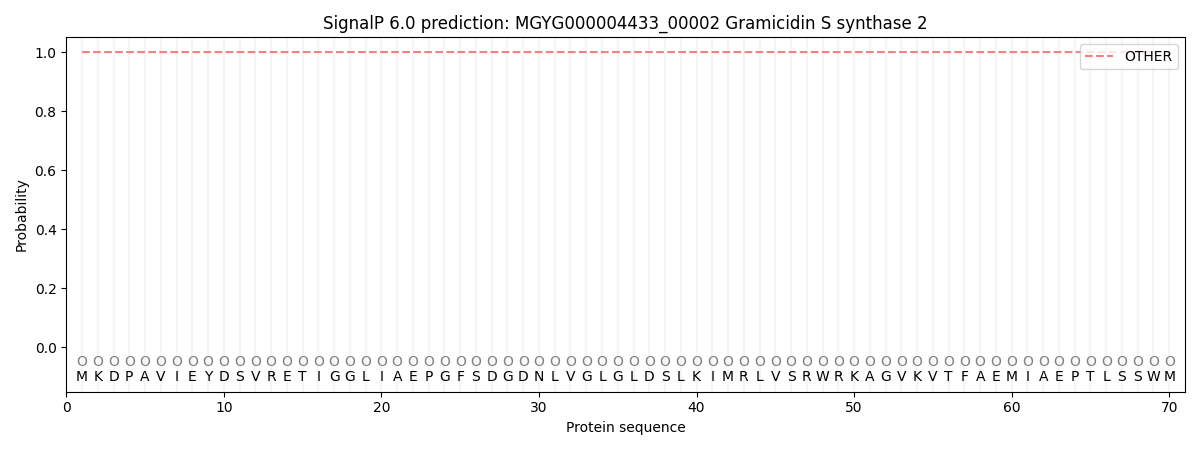
| Other | SP_Sec_SPI | LIPO_Sec_SPII | TAT_Tat_SPI | TATLIP_Sec_SPII | PILIN_Sec_SPIII |
|---|---|---|---|---|---|
| 1.000057 | 0.000000 | 0.000000 | 0.000000 | 0.000000 | 0.000000 |