

You are browsing environment: HUMAN GUT
CAZyme Information: MGYG000004449_01151
You are here: Home > Sequence: MGYG000004449_01151
Basic Information |
Genomic context |
Full Sequence |
Enzyme annotations |
CAZy signature domains |
CDD domains |
CAZyme hits |
PDB hits |
Swiss-Prot hits |
SignalP and Lipop annotations |
TMHMM annotations
Basic Information help
| Species | ||||||||||||
|---|---|---|---|---|---|---|---|---|---|---|---|---|
| Lineage | Bacteria; Firmicutes_A; Clostridia; TANB77; CAG-508; CAG-245; | |||||||||||
| CAZyme ID | MGYG000004449_01151 | |||||||||||
| CAZy Family | CBM50 | |||||||||||
| CAZyme Description | hypothetical protein | |||||||||||
| CAZyme Property |
|
|||||||||||
| Genome Property |
|
|||||||||||
| Gene Location | Start: 3092; End: 4210 Strand: + | |||||||||||
CDD Domains download full data without filtering help
| Cdd ID | Domain | E-Value | qStart | qEnd | sStart | sEnd | Domain Description |
|---|---|---|---|---|---|---|---|
| pfam01510 | Amidase_2 | 1.02e-28 | 20 | 143 | 2 | 121 | N-acetylmuramoyl-L-alanine amidase. This family includes zinc amidases that have N-acetylmuramoyl-L-alanine amidase activity EC:3.5.1.28. This enzyme domain cleaves the amide bond between N-acetylmuramoyl and L-amino acids in bacterial cell walls (preferentially: D-lactyl-L-Ala). The structure is known for the bacteriophage T7 structure and shows that two of the conserved histidines are zinc binding. |
| cd06583 | PGRP | 4.96e-23 | 19 | 144 | 1 | 126 | Peptidoglycan recognition proteins (PGRPs) are pattern recognition receptors that bind, and in certain cases, hydrolyze peptidoglycans (PGNs) of bacterial cell walls. PGRPs have been divided into three classes: short PGRPs (PGRP-S), that are small (20 kDa) extracellular proteins; intermediate PGRPs (PGRP-I) that are 40-45 kDa and are predicted to be transmembrane proteins; and long PGRPs (PGRP-L), up to 90 kDa, which may be either intracellular or transmembrane. Several structures of PGRPs are known in insects and mammals, some bound with substrates like Muramyl Tripeptide (MTP) or Tracheal Cytotoxin (TCT). The substrate binding site is conserved in PGRP-LCx, PGRP-LE, and PGRP-Ialpha proteins. This family includes Zn-dependent N-Acetylmuramoyl-L-alanine Amidase, EC:3.5.1.28. This enzyme cleaves the amide bond between N-acetylmuramoyl and L-amino acids, preferentially D-lactyl-L-Ala, in bacterial cell walls. The structure for the bacteriophage T7 lysozyme shows that two of the conserved histidines and a cysteine are zinc binding residues. Site-directed mutagenesis of T7 lysozyme indicates that two conserved residues, a Tyr and a Lys, are important for amidase activity. |
| COG5632 | CwlA | 1.72e-21 | 3 | 155 | 9 | 162 | N-acetylmuramoyl-L-alanine amidase CwlA [Cell wall/membrane/envelope biogenesis]. |
| pfam08230 | CW_7 | 8.36e-16 | 283 | 321 | 1 | 39 | CW_7 repeat. This domain was originally found in the C-terminal moiety of the Cpl-7 lysozyme encoded by the Streptococcus pneumoniae bacteriophage Cp-7. It is also found in the cell wall hydrolases of human and life-stock pathogens. CW_7 repeats make up a cell wall binding motif. |
| smart00644 | Ami_2 | 9.23e-16 | 20 | 141 | 3 | 126 | Ami_2 domain. |
CAZyme Hits help
| Hit ID | E-Value | Query Start | Query End | Hit Start | Hit End |
|---|---|---|---|---|---|
| QHJ84983.1 | 1.99e-48 | 1 | 371 | 1 | 310 |
| ABK61021.1 | 8.91e-31 | 1 | 158 | 155 | 307 |
| AVJ51161.1 | 9.35e-31 | 279 | 372 | 226 | 319 |
| AVJ51719.1 | 9.35e-31 | 279 | 372 | 226 | 319 |
| AVJ51014.1 | 2.51e-30 | 279 | 372 | 226 | 319 |
PDB Hits download full data without filtering help
| Hit ID | E-Value | Query Start | Query End | Hit Start | Hit End | Description |
|---|---|---|---|---|---|---|
| 1YB0_A | 6.01e-11 | 21 | 158 | 24 | 154 | Structureof PlyL [Bacillus anthracis],1YB0_B Structure of PlyL [Bacillus anthracis],1YB0_C Structure of PlyL [Bacillus anthracis] |
| 2L47_A | 9.21e-11 | 21 | 169 | 24 | 165 | Solutionstructure of the PlyG catalytic domain [Bacillus phage Gamma] |
| 2AR3_A | 2.87e-10 | 21 | 158 | 24 | 154 | ChainA, prophage lambdaba02, n-acetylmuramoyl-l-alanine amidase, family 2 [Bacillus anthracis],2AR3_B Chain B, prophage lambdaba02, n-acetylmuramoyl-l-alanine amidase, family 2 [Bacillus anthracis],2AR3_C Chain C, prophage lambdaba02, n-acetylmuramoyl-l-alanine amidase, family 2 [Bacillus anthracis] |
| 5FIM_A | 9.20e-06 | 299 | 372 | 65 | 146 | Thestructure of Kbp.K from E. coli [Escherichia coli],7PVC_A Chain A, Potassium binding protein Kbp [Escherichia coli K-12] |
Swiss-Prot Hits download full data without filtering help
| Hit ID | E-Value | Query Start | Query End | Hit Start | Hit End | Description |
|---|---|---|---|---|---|---|
| P36550 | 2.62e-18 | 3 | 198 | 5 | 209 | N-acetylmuramoyl-L-alanine amidase CwlL OS=Bacillus licheniformis OX=1402 GN=cwlL PE=3 SV=1 |
| Q99125 | 2.10e-17 | 19 | 198 | 23 | 208 | Probable N-acetylmuramoyl-L-alanine amidase OS=Bacillus licheniformis OX=1402 PE=3 SV=1 |
| O31982 | 3.20e-14 | 18 | 163 | 22 | 178 | N-acetylmuramoyl-L-alanine amidase BlyA OS=Bacillus subtilis (strain 168) OX=224308 GN=blyA PE=3 SV=1 |
| Q49UX4 | 3.15e-10 | 326 | 372 | 84 | 129 | N-acetylmuramoyl-L-alanine amidase sle1 OS=Staphylococcus saprophyticus subsp. saprophyticus (strain ATCC 15305 / DSM 20229 / NCIMB 8711 / NCTC 7292 / S-41) OX=342451 GN=sle1 PE=3 SV=1 |
| Q5HRU2 | 4.40e-08 | 302 | 372 | 123 | 190 | N-acetylmuramoyl-L-alanine amidase sle1 OS=Staphylococcus epidermidis (strain ATCC 35984 / RP62A) OX=176279 GN=sle1 PE=3 SV=1 |
SignalP and Lipop Annotations help
This protein is predicted as OTHER
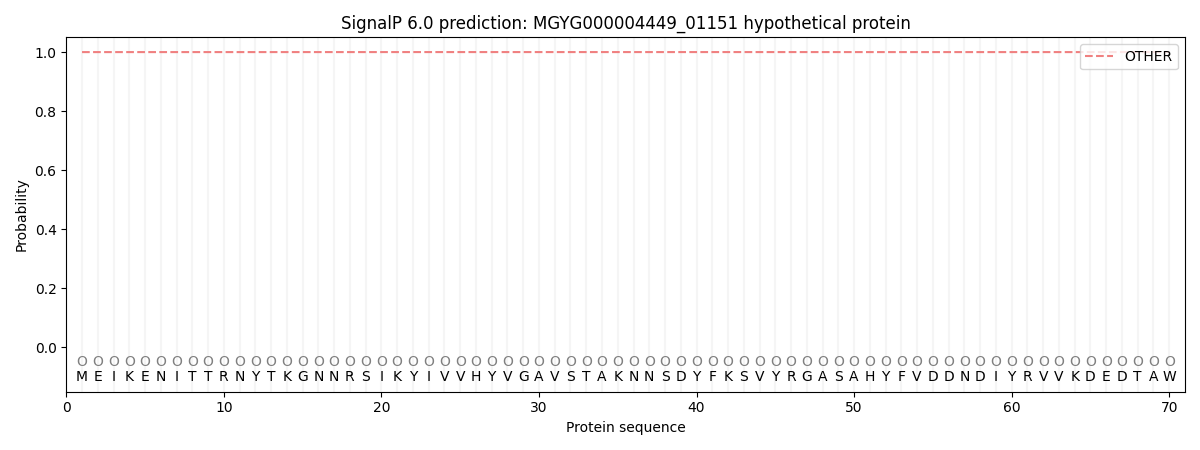
| Other | SP_Sec_SPI | LIPO_Sec_SPII | TAT_Tat_SPI | TATLIP_Sec_SPII | PILIN_Sec_SPIII |
|---|---|---|---|---|---|
| 1.000061 | 0.000000 | 0.000000 | 0.000000 | 0.000000 | 0.000000 |