

You are browsing environment: HUMAN GUT
CAZyme Information: MGYG000004904_01630
You are here: Home > Sequence: MGYG000004904_01630
Basic Information |
Genomic context |
Full Sequence |
Enzyme annotations |
CAZy signature domains |
CDD domains |
CAZyme hits |
PDB hits |
Swiss-Prot hits |
SignalP and Lipop annotations |
TMHMM annotations
Basic Information help
| Species | ||||||||||||
|---|---|---|---|---|---|---|---|---|---|---|---|---|
| Lineage | Bacteria; Firmicutes_A; Clostridia; TANB77; CAG-508; CAG-492; | |||||||||||
| CAZyme ID | MGYG000004904_01630 | |||||||||||
| CAZy Family | GH25 | |||||||||||
| CAZyme Description | hypothetical protein | |||||||||||
| CAZyme Property |
|
|||||||||||
| Genome Property |
|
|||||||||||
| Gene Location | Start: 2463; End: 3587 Strand: + | |||||||||||
CAZyme Signature Domains help
| Family | Start | End | Evalue | family coverage |
|---|---|---|---|---|
| GH25 | 7 | 191 | 8.1e-35 | 0.9830508474576272 |
| CBM50 | 332 | 374 | 2.5e-17 | 0.95 |
CDD Domains download full data without filtering help
| Cdd ID | Domain | E-Value | qStart | qEnd | sStart | sEnd | Domain Description |
|---|---|---|---|---|---|---|---|
| cd06414 | GH25_LytC-like | 1.85e-41 | 4 | 202 | 2 | 191 | The LytC lysozyme of Streptococcus pneumoniae is a bacterial cell wall hydrolase that cleaves the beta1-4-glycosydic bond located between the N-acetylmuramoyl-N-glucosaminyl residues of the cell wall polysaccharide chains. LytC is composed of a C-terminal glycosyl hydrolase family 25 (GH25) domain and an N-terminal choline-binding module (CBM) consisting of eleven homologous repeats that specifically recognizes the choline residues of pneumococcal lipoteichoic and teichoic acids. This domain arrangement is the reverse of the major pneumococcal autolysin, LytA, and the CPL-1-like lytic enzymes of the pneumococcal bacteriophages, in which the CBM (consisting of six repeats) is at the C-terminus. This model represents the C-terminal catalytic domain of the LytC-like enzymes. |
| cd00599 | GH25_muramidase | 9.54e-23 | 4 | 201 | 1 | 186 | Endo-N-acetylmuramidases (muramidases) are lysozymes (also referred to as peptidoglycan hydrolases) that degrade bacterial cell walls by catalyzing the hydrolysis of 1,4-beta-linkages between N-acetylmuramic acid and N-acetyl-D-glucosamine residues. This family of muramidases contains a glycosyl hydrolase family 25 (GH25) catalytic domain and is found in bacteria, fungi, slime molds, round worms, protozoans and bacteriophages. The bacteriophage members are referred to as endolysins which are involved in lysing the host cell at the end of the replication cycle to allow release of mature phage particles. Endolysins are typically modular enzymes consisting of a catalytically active domain that hydrolyzes the peptidoglycan cell wall and a cell wall-binding domain that anchors the protein to the cell wall. Endolysins generally have narrow substrate specificities with either intra-species or intra-genus bacteriolytic activity. |
| cd06523 | GH25_PlyB-like | 2.71e-19 | 6 | 200 | 3 | 176 | PlyB is a bacteriophage endolysin that displays potent lytic activity toward Bacillus anthracis. PlyB has an N-terminal glycosyl hydrolase family 25 (GH25) catalytic domain and a C-terminal bacterial SH3-like domain, SH3b. Both domains are required for effective catalytic activity. Endolysins are produced by bacteriophages at the end of their life cycle and participate in lysing the bacterial cell in order to release the newly formed progeny. Endolysins (also referred to as endo-N-acetylmuramidases or peptidoglycan hydrolases) degrade bacterial cell walls by catalyzing the hydrolysis of 1,4-beta-linkages between N-acetylmuramic acid and N-acetyl-D-glucosamine residues. |
| cd00118 | LysM | 2.90e-17 | 330 | 374 | 1 | 45 | Lysin Motif is a small domain involved in binding peptidoglycan. LysM, a small globular domain with approximately 40 amino acids, is a widespread protein module involved in binding peptidoglycan in bacteria and chitin in eukaryotes. The domain was originally identified in enzymes that degrade bacterial cell walls, but proteins involved in many other biological functions also contain this domain. It has been reported that the LysM domain functions as a signal for specific plant-bacteria recognition in bacterial pathogenesis. Many of these enzymes are modular and are composed of catalytic units linked to one or several repeats of LysM domains. LysM domains are found in bacteria and eukaryotes. |
| pfam01183 | Glyco_hydro_25 | 9.48e-17 | 7 | 191 | 2 | 179 | Glycosyl hydrolases family 25. |
CAZyme Hits help
| Hit ID | E-Value | Query Start | Query End | Hit Start | Hit End |
|---|---|---|---|---|---|
| AZQ41958.1 | 1.55e-60 | 1 | 374 | 1 | 314 |
| QBX22842.1 | 8.85e-60 | 1 | 374 | 1 | 315 |
| QUB39818.1 | 1.88e-58 | 1 | 374 | 1 | 314 |
| ADU27377.1 | 3.22e-48 | 1 | 313 | 1 | 315 |
| AVQ96437.1 | 3.22e-48 | 1 | 313 | 1 | 315 |
PDB Hits download full data without filtering help
| Hit ID | E-Value | Query Start | Query End | Hit Start | Hit End | Description |
|---|---|---|---|---|---|---|
| 5JCD_A | 1.16e-10 | 258 | 374 | 73 | 191 | Crystalstructure of OsCEBiP [Oryza sativa Japonica Group],5JCD_B Crystal structure of OsCEBiP [Oryza sativa Japonica Group],5JCD_C Crystal structure of OsCEBiP [Oryza sativa Japonica Group] |
| 5JCE_A | 3.72e-10 | 258 | 374 | 73 | 191 | Crystalstructure of OsCEBiP complex [Oryza sativa Japonica Group],5JCE_B Crystal structure of OsCEBiP complex [Oryza sativa Japonica Group] |
| 2WW5_A | 5.04e-08 | 8 | 202 | 281 | 468 | 3D-structureof the modular autolysin LytC from Streptococcus pneumoniae at 1.6 A resolution [Streptococcus pneumoniae R6],2WWD_A 3D-structure of the modular autolysin LytC from Streptococcus pneumoniae in complex with pneummococcal peptidoglycan fragment [Streptococcus pneumoniae R6] |
| 4B8V_A | 1.02e-07 | 264 | 374 | 38 | 160 | ChainA, Extracellular Protein 6 [Fulvia fulva],4B9H_A Chain A, Extracellular Protein 6 [Fulvia fulva] |
| 2WWC_A | 1.18e-07 | 8 | 202 | 281 | 468 | 3D-structureof the modular autolysin LytC from Streptococcus pneumoniae in complex with synthetic peptidoglycan ligand [Streptococcus pneumoniae R6] |
Swiss-Prot Hits download full data without filtering help
| Hit ID | E-Value | Query Start | Query End | Hit Start | Hit End | Description |
|---|---|---|---|---|---|---|
| Q49UX4 | 6.85e-21 | 266 | 374 | 24 | 129 | N-acetylmuramoyl-L-alanine amidase sle1 OS=Staphylococcus saprophyticus subsp. saprophyticus (strain ATCC 15305 / DSM 20229 / NCIMB 8711 / NCTC 7292 / S-41) OX=342451 GN=sle1 PE=3 SV=1 |
| Q8CMN2 | 7.11e-19 | 257 | 374 | 70 | 190 | N-acetylmuramoyl-L-alanine amidase sle1 OS=Staphylococcus epidermidis (strain ATCC 12228 / FDA PCI 1200) OX=176280 GN=sle1 PE=3 SV=1 |
| Q5HRU2 | 7.11e-19 | 257 | 374 | 70 | 190 | N-acetylmuramoyl-L-alanine amidase sle1 OS=Staphylococcus epidermidis (strain ATCC 35984 / RP62A) OX=176279 GN=sle1 PE=3 SV=1 |
| Q6GJK9 | 8.09e-17 | 269 | 374 | 91 | 201 | N-acetylmuramoyl-L-alanine amidase sle1 OS=Staphylococcus aureus (strain MRSA252) OX=282458 GN=sle1 PE=3 SV=1 |
| Q5HIL2 | 1.10e-16 | 269 | 374 | 91 | 201 | N-acetylmuramoyl-L-alanine amidase sle1 OS=Staphylococcus aureus (strain COL) OX=93062 GN=sle1 PE=3 SV=1 |
SignalP and Lipop Annotations help
This protein is predicted as OTHER
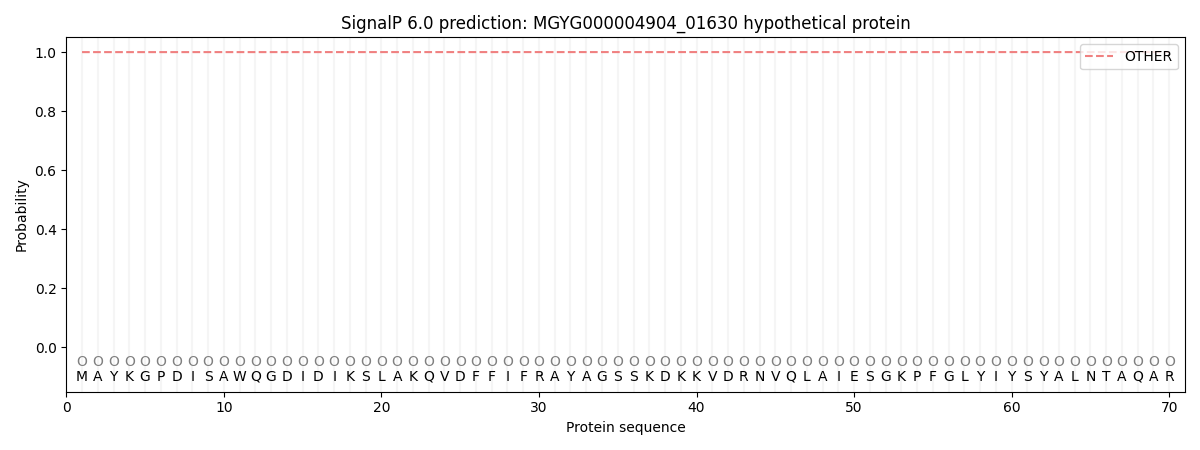
| Other | SP_Sec_SPI | LIPO_Sec_SPII | TAT_Tat_SPI | TATLIP_Sec_SPII | PILIN_Sec_SPIII |
|---|---|---|---|---|---|
| 1.000038 | 0.000000 | 0.000000 | 0.000000 | 0.000000 | 0.000000 |